Welcome! Today I’ll show you some of my favourites from my historical wardrobe and give you my best advise on what to choose for your own outfit. Let’s start with veils.
My current favourite is the semicircle veil in different sizes. It is easy to drape and style, and the semicircle cut gives it a smooth and flowing drape. Here are some examples:
large semicircle veil
medium veil from behind
The measures on my different veils:
small: diameter 85 cm (the straight front edge) length 55 cm (from front head to the back).
medium: diameter 100 cm, lenght 58 cm.
large: diameter 140 cm, lenght 60 cm.
small semicircle veil
This is a larger semicircle veil in wool muslin fabric, worn over braids, cap and wimple. Pinned in place by the temples and in the back of the neck:
winter wool veil
To make one: Use a thin tabby linen (90-120 gram/m2) with an even weave. Presoak and wash before sewing to avoid shrinking in the future. I draw the measures directly on the fabric; a semicircle shape following the measures above. The reason for not making a mathematical semicircle is more a matter of taste; how long you want the front edge to be and how much fabric you want in the back. Try it out and see what you like!
I make small double folded edges and whip stitch them with silk sewing thread or 60/2 thin linen thread, vaxed before sewing.
The rectangular veil is a very useful veil that can be worn in several ways. It has a straighter fall than the semicircle, but is ideal for wrapping or draping around the neck, like this:
rectangular veil
rectangular veil with decorative edge
If you make the rectangular veil longer it becomes what I call a Great veil:
great veil for wrapping
The great veil above measures 55*250 cm and is great for creating turban styles seen in the 15th century.
The measures of some of my veils:
Simple rectangular veil: 55*150 cm
Veil with a decorative edge in linen: 50*150 cm
Great veil: 50*250 to 55*350 cm
Use the same quality linen fabric as above, and the same seams.
Shorter Great veil (200-250 cm) worn wrapped around the head, the end folded over the head and resting on top.
When sewing veils for wrapping, I find it easier to use them if they are not to wide. 50-55 cm is enough.
silk veil
Square veils are the hardest to style in my opinion. This model was the first I tried out, but we never made a great team. I do have one left though; my silk veil with freshwater pearls. Silk veils are high status veils, and look great. They are also very light, so you barely feel them on your head.
If you want to make a silk veil for yourself, use a fabric with a heavy drape and thin enough to be a little transparent. Sew the edges double folded with running stitches or even better; make a rolled hem with invisible stitches. (Or buy one ready-made from me with an email/pm).
Measures for a square veil: 80*80 cm or bigger (the silk one above is around 90*90 cm.)
This style is actually two or three different pieces: a cap with a folded strip of fabric pinned on, and a great veil on top. It is a simplification of the large head dress the fashionable woman wore during a preiod of the 15th century. Painting shows headwear with many folds or layers, held in place with pins, basting (or some kind of magic). But since I live in a tent during summer events (and not a comfortable house with a maid) I need simplified ways to dress myself. This was one option that came out nicely, it is both easy to pack and manage during medieval camping, and easy to dress myself in. It should be more tightly pulled in the neck though- contemporary pictures shows no such fabric volume in the neck.
simple style turban
This is another way to style the Great veil, for that “I am hard working but yet fashionable” look. The veil is pinned directly around the head without any shaping braids, padding or cap, and wrapped around the head a couple of times. It is then pinned down to the layers below, and the end left hanging.
To avoid bulky fabric in the neck, I have found that it is better to pin all models of veils in place instead of tying them.
Veil measures: 55*250 cm, thin linen with double folded edges.
Buying fabrics for veils?
Thin linen 90-120 g/m2 with an even weave, a semitransparent and drapey silk, or a fine wool muslin fabric are the materials used above. There’s no find of wool veils, but I use the fabric when I need to stay warm, and for its beautiful colour tone and drape. It is hard to find linen good enough for veils today.
Threads: I use 60/2 thin linen thread for linen veils, and silk sewing thread for wool and silk veils.
Type of stitch: Hand stitching is a good choice for veils since they are very visible, and the drape will look very different with a machine seam. I always fold the hem twice, as narrow as I can before sewing. Whipstitching is always a good choice, but running stitching will do the work faster and create a more discreet seam. Perfect if you have a very thin fabric, or are in a hurry. Silk fabric edges I like to roll and sew with an invisble seam.
variations; linen rectangle worn double folded.
You can vary your veils in many different styles to fit different periods, fashion and status. Above is the rectangular veil with a decorative edge, folded twice and pinned onto a birgitta cap.
The best way to find your styles is to look at contemporary paintings and portraits and try to replicate the look in front of the mirror. When satisfied- take some photos to remember how you did it. I always end up in early spring wondering what veil style I should wear for which outfit…
In this tutorial, a gore is a triangular-shaped piece of fabric sewn into the garment. A gusset is a square piece of fabric, sewn into the armpit to add movability and space, used on shifts and shirts to take a few examples.
How do they work?
A gore inserted in your sleeve will add space and freedom of movement. Depending on the placement of the gore in the sleeve, it will add space to different effects, like moving your arm up and forward or adjusting your sleeve to larger muscles in your arms.
Why do you want to use gores in sleeves?
Gores might have several reasons to be where they are:
To save fabric while cutting out your fabric pieces.
To add movability by cutting the gore on another grain than the rest of the sleeve.
To mend a broken sleeve or seam.
To enlargen a sleeve being to narrow.
Gores might be inserted while making your garment, but also afterwards if you feel a need to adjust the fit. This guide shows you how to put in a gore in a cut slit at the front of the sleeve, but you can also add gores to the seam on an S-shaped sleeve. The principle is the same; fitting the sleeve into the armhole and then adding as much gore as you need to make the sleeve ”whole”.
An example of how this method was used during the medieval period is the Moy Bog dress, which has a similar gore. Maybe an adjustment to add space to a new wearer that had more mass over arms and shoulders?
The easiest way to make well-fitted sleeve gores is to cut out a piece of fabric, pin/baste it on the inside of the assembled garment, and sew it in place. Here is a step to step guide on how I do:
14th-15th c short sleeved dress
This dress has a tight fit, and I decided on a small gore in the sleeve front to add a bit more flexibility and movement.
I started with inserting the sleeve in the armhole and then cutting up a slit in the front to make the sleeve fit all around (this means you will have to make a sleeve that has a slightly smaller measure than the armhole if you make a new dress.) When I am satisfied with the inserted sleeve and slit, I press the seam allowance to the inside and start with the pattern for the gore.
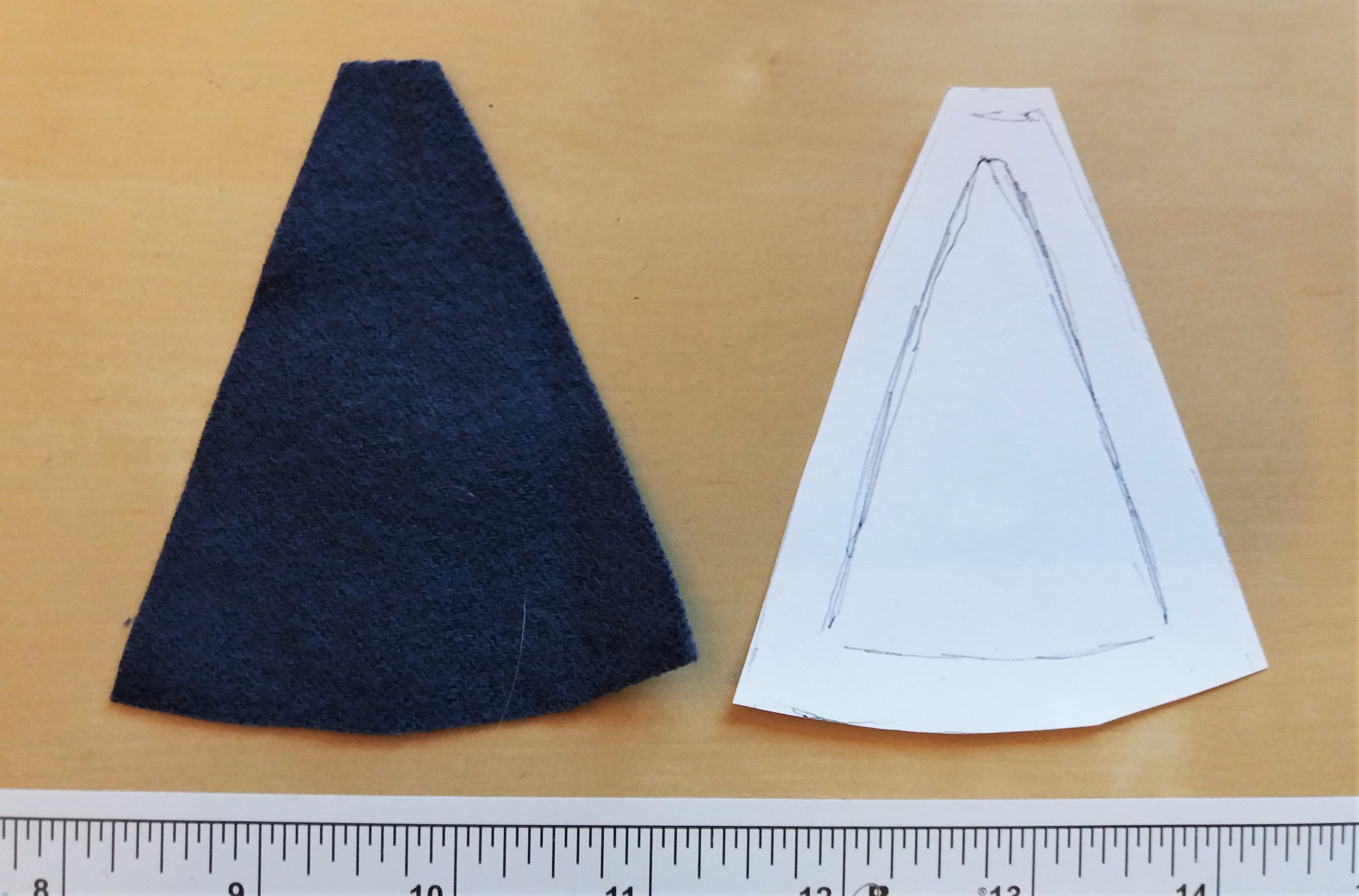
Put a piece of paper on the inside of the dress, and smooth the fabric on top of this. Draw a paper draft for the gore by tracing the ”hole” on your paper. Very easy!
Add seam allowance around the draft, and cut out.
Put the paper pattern onto fabric and draw + cut two gores, one for each sleeve. Remember to mirror the pattern and mark the gore with up/down and front/back.
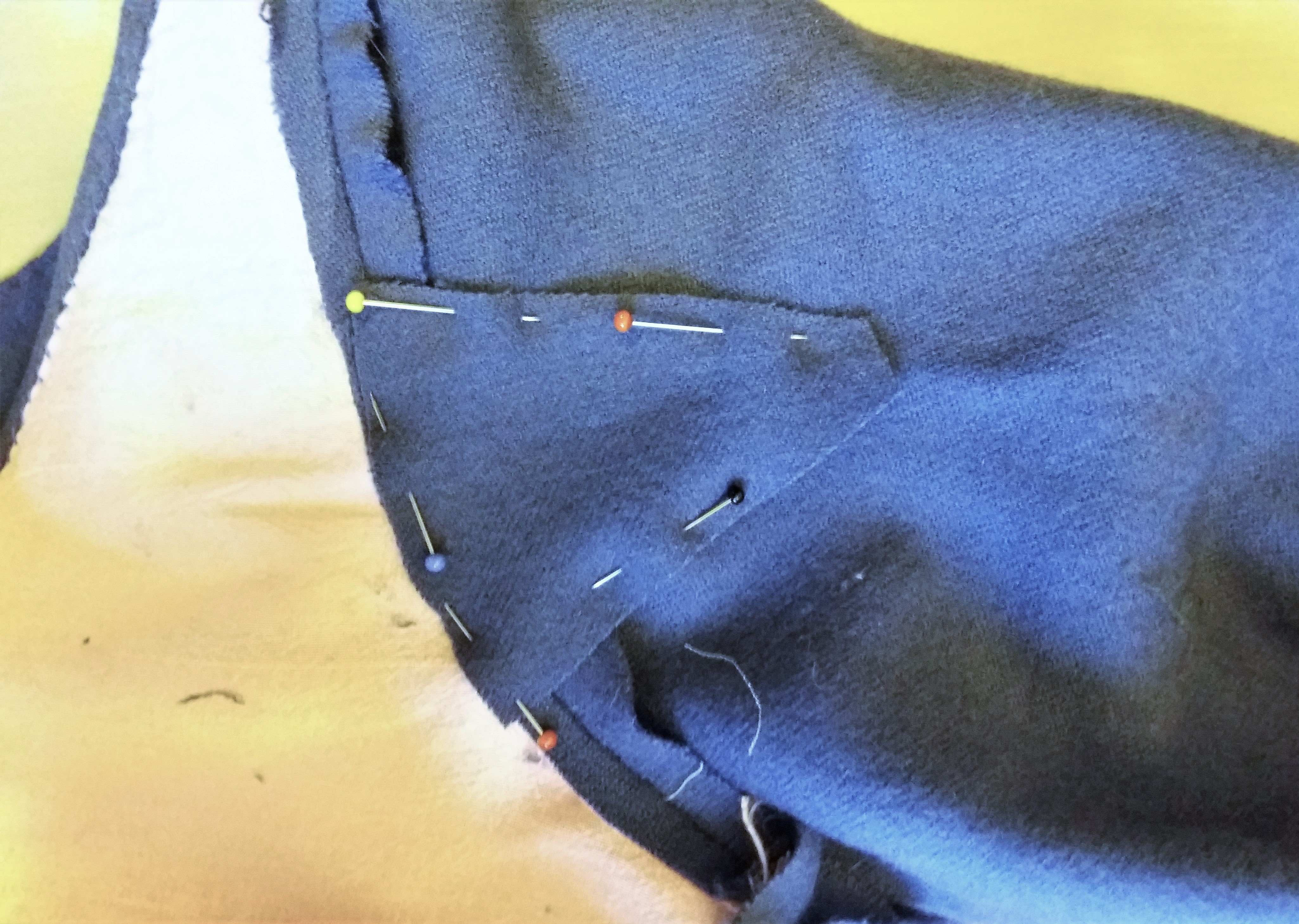
Fit the fabric gores into the sleeve slits, and pin in place (here I worked on the inside, but if you find it easier you can work from the outside of the garment).
This is what it looks like from the right side of the dress:
With pins in place, baste or sew the gore into your garment. Here I used small whip stitching, not bothering with basting. But if you are unsure or want to test the fit before sewing, basting is a great way to do that. Fastening the gore from the right side of the garment makes it easy to get a good result, since you can see the result while sewing.
When I have inserted the gore, the seam allowance is most often pressed to either side (down to the sleeve) and whip stitched down. I always press the s.a towards the bigger fabric piece. For example, sewing it down onto the sleeve and/or body piece. After that, it is all done!
The new blue gown also has a gore in the front of the sleeve, barely visible but great for movement!
Back in 201something (2016 maybe?) I made this outfit with a brown woolen overdress, based on Drei Schnittbücher by Katherine Barich/Marion McNealy. I wrote a research post to summarize my background research and thoughts but never got around to writing about the finished outfit. The research focused on middle Europe in the early 16th century, but when I found the book with pattern drafts I took the sidestep to try and make the gown after one of the models presented, even though it might be more probable to have made a dress with a waist seam like my trossfrau dress. But who can resist a fun pattern draft from a medieval tailoring book?
Since then, I have been wearing this outfit several times and even adjusted the dress with a lower neckline and a piece of mending over one of the skirt folds. I like this outfit since it is both pretty and comfortable for working, so I thought I would share it with you.
Winter event, with all three layers
I start with a basic linen shift in half bleached linen, based on my tutorial. It has a square cut neckline to match the dress and kirtle, and long sleeves.
Over that, I wear a kirtle or middle dress in wool, sleeveless and simple. This is a really practical working garment, and allow me to roll up the shift sleeves when doing dishes. Back then, I had a yellow sleeveless dress, that got sold to make a new one, one size larger.
Unfortunately, I got sidetracked when making that and decided on an Italian styled dress that is also shown in this tutorial. After that, I realised I really needed a middle layer to make this outfit complete, and made another kirtle in grey-blue wool, with a decorative fabric strip in black wool.
Both the middle layer and the overdress is rather tight fitted, giving me bust support when worn.
(This is what it looked like at first before I moved the neckline down a bit)
The overdress is made in brown wool with decorative borders in amber coloured wool. I liked this dress pattern since it is quite different from others I had tried, and I fell for the challenge. Sadly, the tailor books do not come with much information about how one should assemble all the pieces, so you could best describe this as a try on a medieval pattern, rather than something strictly copied.
I adjusted the cutting out of the fabric pieces to fit the fabric I had available, which was around 300*150 cm of wool. I also choosed to widen the skirt at the back to make it look more like the artwork from the period. The tailoring book shows the centre back (and front) straight, but that does not give the desired folds seen on women. Maybe a gore was supposed to go in there, or some other adjustment that was so obvious none bothered to write it down? To accommodate for the skirt width, I had to piece the sleeves with three different fabric scraps to get the dress together.
The front piece is folded at the centre front, making the skirt without a seam in the front.
The back pieces are pieced at the hem for fuller width
One of the sleeves, basted for trying on.
pattern pieces from the book
The overdress (well, the entire outfit) is sewn by hand, and on this dress, I only used linen thread, a choice I based on research for the period. Sadly, I have misplaced many notes and sources so the only reference I have left is a note saying “linen thread common for working-class clothing, do not bother with silk or wool). Ok, I apparently did that…
The skirt panels and some longer seams are made with running stitches, and the rest of the dress is sewn with backstitching, and the seam allowances are sewn down with whipstitching. The decorative fabric pieces are also whip stitched in place. On the inside, the dress is lined with a piece of sturdy linen fabric in the body, and the front closing is reinforced with a piece of linen canvas and closed with hooks and eyes. Another possibility would be lacing, but I like how fast the dressing is with hooks and eyes!
I found this model harder to fit than the 16th c models with waist seam, since you can’t adjust the waist placement during fitting. It has to be cut out at the beginning. I like to raise the waistline 1-2 cm above my natural waist to achieve the early 16th c silhouette, and that was more difficult here. But the dress made up for it by being really fun to assemble with the skirt folds.
I folded the skirt part that stretches outside the body in several folds and fastened these to the sides and centre back of the body. This gave a lot of strain on specific parts of the dress, causing the folds to rip when someone accidentally stepped on the dress hem. So I mended that side with a piece of fabric.
Here you can see the folds in the centre back and sides.
If I were to remake this whole pattern, I would choose to cut a slit between the body and skirts and fit the skirt in folds as you do on 18th c clothing. But this was several years ago and I hadn’t tried that technique yet.
Side view showing the gathered skirt fabric in the side; drapey and voluminous!
The greatest thing about this pattern was the drape of the skirt. It is full and generous and the folds look great in the centre back and sides. The front on the other hand is straight, with just an extra 15 cm overlap to allow for getting out of the dress. I just fold the gap shut and wear an apron above, but you could pin or hook it in place, or make a slit in the front. The straightness of the front makes the skirt great to work in; when I bend forward the skirt rearrange itself towards my legs, avoiding any flames or obstacles before me. Someone gave this thought “back then”!
The gollar I already made a tutorial for, and you can find it here. The early photos show an amber coloured English broadcloth gollar, fully lined with fur. The red one only has fur strips, enough to add some warmth but still be conveniently small for packing in a suitcase… Erh, I mean historically stylish yet cheap. Yeah?
The cap is a simplified Birgitta cap, and should be worn with a veil on top to be considered “well dressed for the public”. These caps are unusual in contemporary finds from the 16th century, I have seen a model doll and some “maybe” examples in art- it could be a cap but could also be a folded veil or other headwear. Hairnets, veils, braids, straw hats and other kinds of headwear are also visible. The most important is to have your head “dressed”; either with a hairstyle or headwear appropriate to the period.
You can find my pattern on the Birgitta cap at my Patreon or in my Etsystore.
The hoses are the same knee-high wool hose I use for other outfits, and here is a tutorial to make your own.
The apron is made in handwoven linen and smocked with linen thread. Two double folded strips of fabric were sewn shut to form the bands that I tie the apron with. The rest of the apron is only double hemmed and sewn with whipstitching.
When I went back to my old research post I also remembered that I wrote that I needed a jacket and a cloak, amongst other things. I actually made several examples of wool jackets, but they never made it to the blog for some reason. A black wool jacket based on the same tailoring manuscript book as the dress got photographed at an event, but then I sold it to make another one and try out some variations.
photo: Annika Madejska
Phew! So this was a lot of thoughts, and sewing, and years gone by without finishing up the writing on this project. I seldom return to old projects like this one, but since I still like it I thought it would be fun to share it with you. It is not a tutorial of any kind, more of a diary or a presentation of a project done.
Sometimes when you see others on the internet doing cool projects and posting photos of fancy dresses it is easy to feel like you don’t get anything done, but sometimes the road to finished projects can be long, windling and a bit unsure. It is ok too!
My Patreons wished for more research to be published, and I am happy to do so! Want to support the blog and be able to ask for content? Consider joining my supporters here!
Welcome to this blogpost about luceting! This post was made with the support from my Patreons!
A lucet cord is made out of interlocking loops and is a really practical way to make cords/strings for lacing garments, garters, shoelaces and more since it is stretchy and durable. I prefer working with wool or silk thread, a thin 2ply yarn or an embroidery yarn with a higher twist. Avoid chunky or uneven yarns since these will offer you problems and break.
This is how my luceting fork looks, but you may use practically anything with two pointy things and a handle, for example, a regular fork with the middle part removed. The historical finds looks quite different, here is one medieval example from Historiska Museet:
I find this a bit harder to use, but with a crocheting needle or pointy stick, it is easier. Lucet forks can be found from both the late iron age/viking age and medieval period. Susanna Broomé writes about viking finds in her booklet Cords and braids (I recommend her booklets.)
Finds of lucet cord are made of wool or silk (and in one case even silk and gold thread). If your thread of choice is too thin and you want a thicker cord, you can use two threads at the same time, treating them as one. But learning with a single thread is faster at the start!
Here is a written instruction:
Start with a thread, making an 8 figure around your fork. Hold the thread end with your hand, and twist the lucet fork ½ a turn, while you make a new loop with the other hand and pull the old one down into the cord. The loops should be pulled tightly into knots. Continue with this until you have a cord the lenght you desire. If you lose yourself, the loop that is easiest to tighten is the newest one, so continue with the old loop first.
And here are videos showing you how to start…
…And how to finish!
Also, a photo series showing the finishing if you prefer that:
Cut off your thread, leaving a bit for fastening.
Put this thread through the old loop, the one you would work with next. Remove from the fork.
Pull it tight.
Put the thread through the new loop, and remove this from the fork. Pull tight. Done!
Now your lucet cord is finished and ready to use. If you cut it in the future, you can either redo this finishing by unravelling a bit of cord or just make a knot at the end.
You know when you are browsing fabrics, looking for something practical and discreet to make a working garment with? Yeah, that didn’t go as planned here…
I fell in love with this silk brocade and bought several meters of it during Double Wars. I had no plan at the moment, but it was lovely and the pattern a replica from the 15th century, so I figured I would find it useful. However, it took a couple of years to come around to cutting the fabric and making it into this gown:
15th century silk brocade dress
buying the fabric
Research:
I collected some examples of dresses that I liked that would fit the time period, social status and use for this fabric. This one is a favourite, painted by Pedro Berruguete around 1485, but I already made a tight fitted one when I made my velvet overgrown for the wedding, so I opted for a looser style now.
The weave, material and pattern of the fabric place this project at the top of the social structure in 15th century Europe, something to be worn by royalty. Brocades are most often seen as outer garments, with wide panels and a loose fit (the better to be taken apart and remade for the next wearer?) Here’s my pinterest board with examples. This fits my fabric well, since it is quite stiff, with a dramatic drape.
The model is best described as an overdress or houppelande, with narrow S-sleeves. The panels starts to get wider below the armhole, and adds as much volume as possible to the hem. The neckline is cut in a V-shape and slightly rounded in the back. I made the back panels longer to get a train and cut the middle front straight and floor-length to be able to walk in it without tripping over the hem.
Working with brocade fabric:
When making silk brocade garments for yourself, remember that you need more seam allowance than you use when sewing in wool or linen. First, the fabric will often shred and loose threads everywhere, and second, the brocade is often stiff and does not give any flexibility when worn. I calculated 1 cm extra seam allowance (2,5 cm instead of 1,5 cm) and another 2-4 % of the total measure for movement (if your pattern is 100 cm around the bust, the total will be 102-104 cm + seam allowance).
I do not wash silk brocades before sewing, instead, I steam them with an iron. This will lose the weaving tension without altering the fabric appearance overly much.
When drafting the pattern pieces, remember to adjust them to the fabrics pattern and right/wrong side. This means that if you want to use your fabric wisely, half the dress will have the pattern running in the ”wrong” direction. On my dress, the pattern is ”upside down” on the back panels, and the right way in the front. The fronts are not matched pattern-wise but cut out to maximize the use of the fabric. To the modern eye, this might feel wrong, but never mind modern ideals! Also, piecing in the skirt or sleeves does not have to follow the pattern direction, just use what scraps you have.
zigzag your edges after cutting
After cutting your fabric pieces, I recommend zigzagging or overlocking the edges on your sewing machine, even if you are about to hand sew your garment and will have to rip away the threads while you work. This will prevent the seam allowance to disappear before you have even finished sewing the pieces together.
For hand sewing, silk thread and running stitches or backstitching will do fine. Try pinning only in the seam allowances to avoid damage to the fabric, or use small clamps instead of pins. I also like to bast; here is the sleeve sewn into the armhole with a linen basting thread, before backstitching it with silk thread.
brocade sleeve inserted to armhole
If you prefer to sew your garment on a machine, use a silk thread and a little longer stitches than normal, to allow for a good looking seam. You might want to adjust the thread tension a bit- try on some scraps first!
I press all my seams while working (with steam and a cloth), to make them tidy and easier to sew down. If you don’t want to fell the seams, leave a zigzag or overlock on the inside. If you prefer to fell the seams, use silk thread and try to press and fold the seam allowance as tight as possible for a nice finish. The hem is also pressed and folded over twice before I whip stitch it in place.
The gown, before the finishing pressing with steam. Notice that the sleeves pulls a bit toward the back? The seam is a bit on the tight side, I should have used looser stitches when closing the sleeve. Now I had to adjust it with a good steam and press to reset the shape. Never underestimate steam!
trying the dress on a mannequin
the back of the gown after pressing, the train turned out great!
I have yet to wear the dress to an event, and I am really looking forward to it. This type of dress needs to be paired with nerdy headwear, sparkly jewellery and a great party!
Update summer 2022: I finally took the gown out during Skellefteå Medeltidsdagar! I actually packed it early in the season, but the weather was so rainy and muddy I didn’t want to wear (and ruin) the dress until July. It really turned out great, and was really comfortable to wear during the party.
At the end of each historical adventure-season I try to clean, mend and grease all our shoes. Outdoors in the autumn sun is of course the most enjoyable, but as long as you get it done it is fine. (Ideally, one would do this after each event to keep the shoes in top condition. But I am lazy…)
Shoe care: soft brush, leather grease with rag and paper.
After each adventure:
Treat your shoes with some grease after each event/market/adventure and also during longer trips. If the shoes get wet, dry them in room temperature or outdoors (never put them by the fire). You may fill them with paper to get them to dry quicker.
How to deep-clean your shoes before putting them away for the winter:
Brush away loose bits and dust, and clean the space between leather and sole by separating these and brushing away small scraps in the crack. Use a soft brush.
Wipe the shoes clean with luke warm water, and a bit of leather soap/regular soap if dirty. Scrub the soles clean with water and soap.
Dry well, filled with paper to hold the shape better.
Treat the leather parts with leather grease. I also grease the soles on turnshoes.
Dry for a day or two, and then store the shoes in a dry space. I usually keep the historical shoes in the wardrobe.
Clean between the sole and leather
Now these pair are cleaned, dried and greased!
Before the next adventure, take out your shoes and grease them again before use!
Mend your shoes as soon as you discover they are broken! A ripped seam or a loose strap needs to be sewn (you can use vaxed linen thread) and a loose rubber sole needs to be glued in place. If you are unsure how to mend the shoe, the shoemaker you bought them from should be able to help you or give you advise. A modern shoemaker/cobbler could also be of help.
Shoes might not be as visible as other garments, but they add to the historical look and experience!
Store your shoes:
Shoes should be kept in a dry space, and can be filled with paper to better hold their shape. Wardrobes, airy shelves or paper boxes are good. Shoes might get moldy if kept damp or squashed together.
How to use your shoes:
Leather turn shoes (with a leather sole) wears out quickly if you walk with them on gravel and asphalt. If you are walking a lot on those grounds, consider to bring a pair of pattens (wooden soles with straps) to protect your shoes. Or change to modern shoes if walking longer distances. I do that during Medieval week in Visby to spare both shoes and knees.
Mud is equally bad for your shoes; try to avoid it, wear pattens, or brush your shoes clean as fast as you can after a muddy experience.
When walking, remember to not drag you feet against the ground, but properly lift your feet to spare the sole. Avoiding glass and sharp stones is also good. If the shoes get a bit large, use an inner sole, a pair of extra socks or leather straps to keep the shoe firmly on your foot. A shoe that moves on your foot will get uncomfortable and wear out faster.
Buying or making historical shoes can be expensive, but with the right use and treatment they will last a long time. I use mine approximately 30 days a year, and they are several years old now!
(Want to make your own shoes? I have a weekend workshop in shoemaking planned for 13-14 November 2021 in Sundsvall, Sweden. Send me an email if you want to know more and join us!)
This post is a collab with Korps and contains advertisement for fabrics
Want to own a really nice cloak? Who doesn’t? (yeah, it was a leading question)
Here is my guide to the perfect cloak; we are going to look at different styles, periods, how to wear it and how to choose the best fabric.
Sources:
Let’s start with some local finds, and the oldest one first: The Gerum cloak is dated to 360-100 BCE and is an oval cloak, worn folded over the shoulders. It is a great cloak woven in a patterned twill, and wearing it folded in the middle, it will look a bit like a semicircular cloak. Wearing a big cloak folded in half, is a good way to add warmth if you don’t have a thick fabric or a lining in your cloak.
Rectangular shawl in tabby wool to a simple viking dress
Viking age cloaks can be seen on runestones, decorations, small figurines and are also mentioned in written sources. I usually call it cloak for a man’s outfit and shawl for a woman’s, but since they have the same function we will just call everything cloaks in this post.
If you fold a square piece of fabric into a triangle and wear it, it will look similar to some female figurines. Rectangular cloaks are another option, where figures are shown wearing an outer garment with corners. If you want to learn more about Viking age cloak theory; check out Viking clothing by Ewing, 2007.
Woad blue cloak or shawl, tabby woven wool fabric
The cloak from Leksand was found in a woman’s grave and is dated to the period 1100-1200. It was made from diamond twill wool, and most likely was a semicircular cloak with an opening at the front, it was also decorated with tablet woven bands at the opening (along the straight side).
The cloak worn by the Bocksten man was also semicircular with a cut hole for the neck, and a seam over one shoulder (the opening was not centered at the front) The cloak was made of several pieces of fabric, pieced together. (Kläderna och människan i medeltidens Sverige och Norge, Eva Andersson, 2006.)
How to draft a semicircular cloak on 150 cm wide fabric; it is really easy!
The cloak that supposedly belonged to St Birgitta of Sweden was also made of several pieces of fabric, but this garment is believed to have been remade from a dress.
During the 13th century, you can see lots of cloaks in contemporary sources (such as the Morgan bible), as the cloak was an important part of the outfit. During the 14th century, there are some really pretty examples of statues with buttons down the front or over one shoulder, and in 15th c paintings, they are often artfully draped in biblical scenes, but not very common in everyday portraits.
Simple semicircular travelling cloak in brown wool twill
16th century cloak patterns from Drei Schnittbucher shows examples of circular cloaks with a front opening, slits, collars and even sleeves sewn onto the cloak.
Full circular cloak pattern, look at that piecing!
Full cloak with sleeves, collar and decorative borders
Interestingthoughts:
In written sources, cloaks go under many different names depending on the time, period, appearance and who the wearer is. There is also evidence of cloaks lined with fur or fabric, cloaks with slits or trains, and of different lenght. Clearly, the garment was both used in a religious context as well as an everyday travel item.
I have not found evidence of hoods or head covering sewn onto the cloak in any finds, and when a hood is shown in contemporary art it is commonly separate from the cloak, even though it might be in the same colour as the larger garment. So if you want to make an outfit close to historical sources, make a cloak and a separate hood that correspond with the fashion of the time. (Hoods on cloaks can be seen in 18th c fashion, but let’s leave that century to another time)
Cloaks may be fastened with a seam, pin, clasp, strings, ribbons, brooch, ring brooches or buttons. Choose your method based on which period you would like it to reflect. Cloaks are fairly common in period art sources, so if you browse through a bunch of paintings you might get the idea on what to choose.
The length of the cloak seems to vary with the wearer; a travelling cloak between the knee and below the calf on men, and a bit longer on women, with ceremonial cloaks trailing behind the wearer. But paintings and prints show evidence of shorter cloaks too, with everything from decorated court cloaks to simple peasant women cloaks. Pick the length that suits your need; too much length and fabric will only weigh you down if you want a practical garment.
example of a semicircular cloak
And as always; piecing is very ok to make use of the fabric!
Different models of cloaks:
Oval cloak, square cloak, rectangular cloak, semicircular cloak (or 1/2 circle cloak), cloak with shoulder seams (or 3/4 circle cloak) and full circle cloak. The Viking age square cloak folded in half is not based on finds but more of an experiment, as is the shoulder seam cloak ( I included that in the picture though, so you may see what I am talking about). The latter I often use when I need to make a larger cloak than the semicircular one but don’t have fabric or historical evidence for a full circular cloak. The seams or piecing could as well be made on other parts of the cloak.
I have found no evidence for the cloak with vertical sections/seams to create a fit (which is popular when buying modern cloak patterns) instead, I would recommend you to choose a simple cut and then drape it on your body to your liking. Small shoulder seams or darts can be made as a more modern solution to make the cloak stay over your shoulders.
The cloak does not need to have an even hem, many examples are just draped over the body or longer back. If you want to make a full circular cloak more even by the hem, you may cut the neck hole nearer the front hem than the back hem (my full cloak is 70 cm at the front, and 80 cm long at the back). Putting the cloak on the body and adjusting the hem afterwards is another method.
Decorations:
Finds, paintings and statues indicate that embroidery, woven bands, silk or a combination of these were used to decorate the cloak, however, these examples are mainly seen on religious or high-status garments. For an everyday cloak, I would go with a sturdy, fulled fabric without decorations. If you want to decorate your cloak; try to find artwork from the period you want to recreate.
Fabric choises:
Wool, unlined or lined with wool or fur is both practical, and the most used material in cloaks during the medieval period. There are examples of velvet and silk cloaks, but only for ceremonial or high-status wearers. A sturdy, dense wool fabric that has been fulled would do well for a cloak, and beyond that, it is more a matter of when you need it (a lined winter cloak or a thinner, fashionable draped summer cloak?) There are examples of both twill and tabby woven cloaks, so again- to find the perfect cloak fabric for your period, status and adventure you would have to do some research for yourself.
Generally speaking, the right kind of fabric and the way you drape your cloak is more important than which model you choose, if you want to look dramatic. Buy enough fabric to give you the size of the cloak you need!
If you just want a good, affordable fabric right now; I include some links here to Korps.se that sells good thick woollen fabrics for cloaks. Very thick and warm fabric, or a softer and warm choice.
Colours:
The best colours for your cloak is: “yeah, it depends on..” you are starting to get this right? Period, area, status, wearer… like with all the other garments the medieval person would buy or make a garment according to what they could afford and what was available/allowed for them. Use artwork again; blues, reds and browns are seen often, and during the late medieval period dark hues and black seems to be popular. A commoner or person living in rural areas maybe had an undyed homemade cloak, while a fashionable burgher would wear something bought, dyed and cut to their taste. The cloak also differed between a garment of fashion and an everyday outer wear for bad weather; let this reflect the colour you choose.
Or, if you prefer, use this information to inspire you into making an awesome fantasy cloak for your next fantasy adventure!
This is a short, and hopeful, encouraging guide to get you started with historical sewing and adventuring.
There are many paths down this hobby, depending on your interests and where you live. Look for local groups and events and what they do, and try out different things.
Some examples on activities/groups to try:
SCA (Society of creative anachronism).
Reenactment groups that specialise in different periods.
Friend-based groups that accept new members.
Larping (live-action role-playing).
Markets/fairs that focus on a period you are interested in.
Landmarks like castles, ruins or museums might have groups helping them create a living environment.
Online meetings, workshops, groups etc.
In some areas, you will find lots of different, open activities to choose from. In others, not so many. Remember; many time travelling enthusiasts travel a lot to get to their favourite activities so even if you don’t find the best parts close to you, there might be others living nearby that you don’t know yet.
If you find anything of interest, be sure to reach out to them, tell them that you would like to join and ask about the requirements. Some groups are open to visit, others are invites only or require you to have a certain standard to your gear before joining. Remember that most groups are voluntary based so you will meet other enthusiasts working for free, not some big business with staff readily available!
What outfit do you need?
This depends on where you are going and what groups you would like to join. Before sewing, it could be a great idea to first scout your options for activities. Some group/fairs/events require you to wear a specific time period for attending. Or if you just love to sew; start with doing different outfits and then go to events where you can enjoy wearing them!
Handcrafting camp at “Medeltidsdagar på Hägnan”.
Generally speaking; when planning your first outfit for going to an event over a day or so linen underwear (shirt/shift) under some kind of wool clothing, maybe with a hat/veil/headwear and a belt with some kind of bag will be enough. A cloak, if you want to stay during the evening, might be good. Shoes are often hard to find at first, but if you have funds to spare webshops offer different models that might do. Again; before spending your hobby budget on something it might be good to wear a pair of discreet sandals or boots on your first trip, and then inquire for tips on footwear. This might save you a lot of money and trouble!
How do you make an outfit?
Nowadays, the internet is bursting with info free to grab and make do with. Start with choosing what period you are really into; Viking age, high Medieval era or the 18th-century court will all have very different styles. The next step is to collect: information, pictures, photos, inspiration… Try to look into both contemporary sources such as books, paintings etc from the period, what research, science and finds show, as well as inspiration from other reenactors. This way, you will build up your own sense of what would be a good choice of clothing.
Buying fabric for your outfit is so much fun, but also hard!
Don’t know where to start? Say you are interested in the 15th century North Europe style; start googling that. Check out artists living in the period (find them on Wiki) and what happened politically and fashionable during this era. (Before you know it, you will be super educated about a whole new period in history…)
Were could you buy an outfit?
Not into sewing… at all? No worries, lot’s of people are not. There are plenty of businesses today selling reenactment gear of different qualities. The problem is, of course, to find the right place with garments and items with a quality that is suitable for what you intend to do. Before shopping (and risk being disappointed) decide on where you want to go and try to connect with a group around that interest/period/area and ask them for good shopping tips. I would of course advise you to go local; shop within your country from seller’s that makes the items themself and may customize them for you. Better quality might cost more, but it also has a better lasting value if you want to upgrade in the future.
Ask a friend!
I know you probably have a thousand questions. Because I had when I started. Am I allowed to bring a toothbrush? What shall I eat? How are people sleeping at that event? Is this expensive? Is it fun? I may of course not answer all questions in this text, but if you are wondering about something specific; feel free to write a comment here and I will do my best to answer everything or send you to someone better suited! And yes, toothbrushes are allowed…
Advise from others:
I asked on my FB page for more advice for beginners and had lots of great suggestions from readers and friends. I didn’t bring them all, but wanted to share some of them!
Karine “Try to find out what you really want to create. Follow your own fire. Ask as many questions as you want. And remember that everybody makes mistakes sometimes. And sometimes mistakes can turn into something even better.”
Elin (translated to English) …”remember to drink water, nap, use sunscreen and eat your meals. Even schedule rest time along with activities. Change clothing for sleeping. A headwear is fantastic! The protect you from heat stroke, sun and can be moisten (to cool you down).”
On the subject on finding new friends: Volunteer! Attend handcrafting workshops. Join Fbgroups.
Adéle “Clothes and gear as a new player: Do -not- compare yourself to others (who might have had years and years of making and gathering their stuff). If you end up having fun and sticking with the hobby, the gear will come. Focus on following the recommendations of the organizers, staying warm and dry, and having fun.”
Agnes: “Try not to fall into the trap of “everybody else has such nice things and I will never be able to create that”. We have all been beginners, everybody starts out with different possibilities to budget, knowledge and amount of time we can put in to the hobby … Most people in the reenactor/sca/larp world are kind and helpful people. If they get told “I like your thing, how did you do it?” they will just be happy to be able to geek out with someone. Don’t expect them to hand you an IKEA kit though. You will have to learn some stuff for your own…”
Maja Elise: “Just start! When I made my first attempt at kit I didn’t know anyone else who did reenactment. Those clothes suck, but I’m so glad I just got started. Fun was had and experience earned.”
Fredrik: “For living history/reenactment, research first, then spend your money. It somebody says that something is ok, ask for their sources. If they can’t provide sources, don’t follow their advice.”
Minna: “Just go for it. You’ll probably want new stuff anyways after your first few events, so keep it simple.”
This is one of my favourites; the “Fässing” (in Swedish), Martebo-sack (from Martebo church on Gotland) or a Wallet (18-19th century). It is a simple, practical linen bag made for carrying loads. I have seen medieval examples worn over your shoulder like below or larger ones strapped over a donkey.
I actually have several of these for my medieval adventures; for grocery shopping, for the picnic, for my showering things like schampoo…
Martebo bag
The bag is made with a piece of sturdy linen or hemp canvas (chose a sturdy tight-woven fabric in linen, or a piece of tent fabric for a large sack).
Cut out a rectangle with the measure 140 * 70 cm, to make a bag suitable for a picnic and your warm hood. Or design your own measures by laying a measuring tape over your shoulder and let it hang down on either side. Adjust and decide on a length you like on the bag, and then decide on the width; between 60-100 cm (makes a bag that is 30-50 cm wide) might be nice. Add 3 cm of SA (seam allowance) to each measure.
Sewing instructions:
1. Mark out the opening on the long sides on the rectangle. It should be in the middle, and between 30-40 cm wide.
2. Put the long sides on top of each other, and sew a seam on either side of the opening. Backstitches with waxed linen thread (if you are using the sewing machine, start with zigzagging the whole fabric piece, then sewing this seam).
3. Press and fold down the SA and whip stitch it down to one side for extra strenght.
4. Hem the opening with whipstitches, working from the inside. It is also good to reinforce the edges of the opening by sewing a couple of extra stitches through each fabric piece to make it less prone to rip open.
5. Now you have a tube, adjust it so the seam is in the middle of the fabric piece inside out, and pin the short edges closed.
6. Sew the edges with backstitching, and repeat the pressing and folded down SA. Done!
The sack may be carried over your shoulder, or wrap it around your wrist and hand to carry it like a grocery bag. If you have valuables in it, you can also make a knot in the middle over the opening to prevent anything from falling out. Very convenient!
Welcome to this step-by-step tutorial, perfect for beginners. It might seem long, but explains everything you need to know. Follow it as you go, or look up the section where you might need extra guidance.
This is a great project to begin with! Easy, straight forward and the fabric won’t be too expensive.
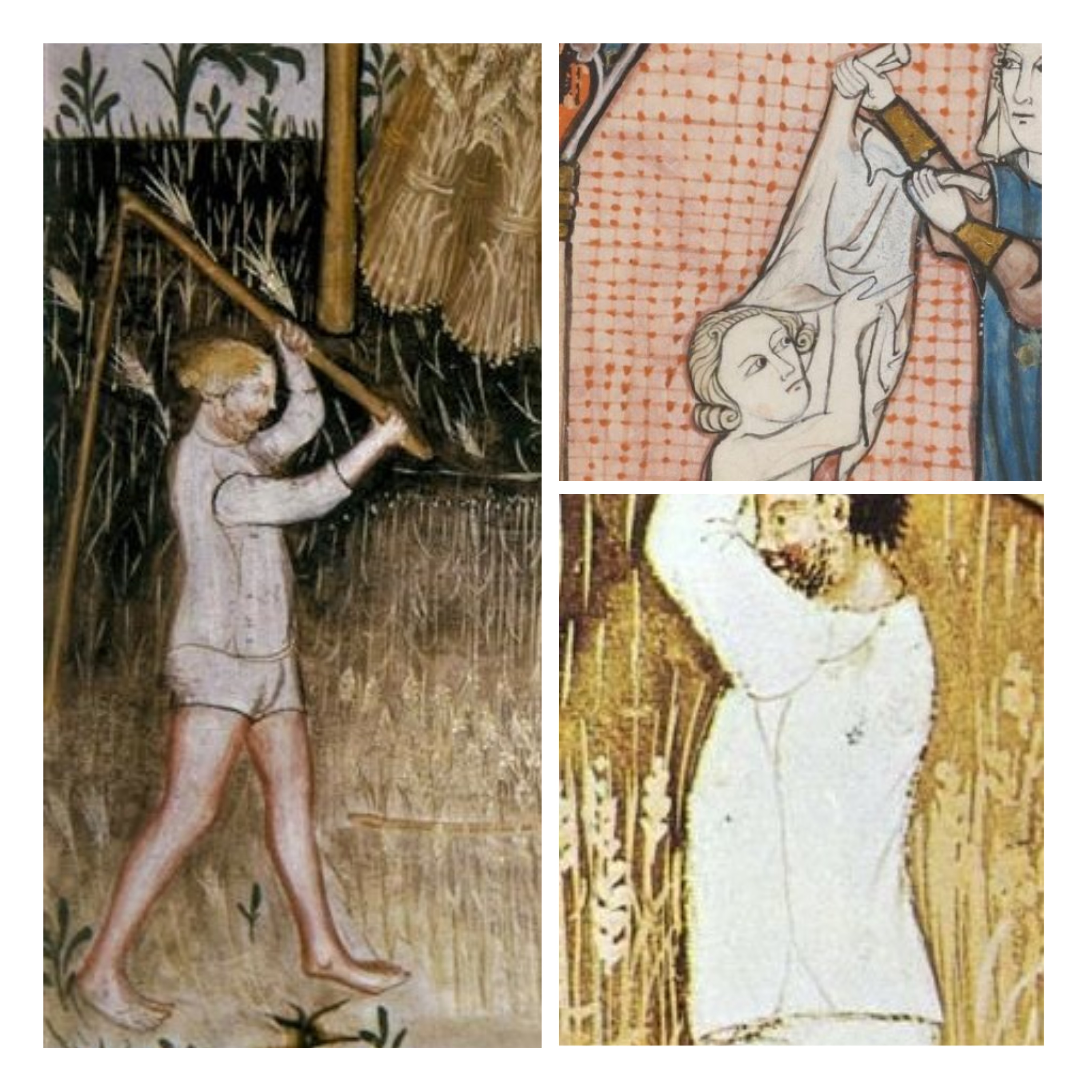
Examples of medieval shirts with slits, gores and seams.
Most people wore linen underwear during the medieval period, and a man’s kit was made up of breeches or a type of loincloth, and the shirt. While you are at it; make two shirts! It is really nice to be able to change and wash your clothes during longer events, and a pleasantly smelling shirt will make it easier to make new friends…
Linen shirt with a slit at the neckhole
Buying fabric:
The amount of fabric you need depends on your size and the width of the fabric. This example will use cloth 150 cm wide. To decide how much you need to buy, calculate the measures on your pieces and how much fabric you need for those, then add another 10% minimum to allow for shrinking or uneven edges. (Fast tip: just buy 2 meters up to XL, a bit more if you have a larger size. Extra fabric may always be used for other projects.)
Look for linen fabric of 120-180 gram, I prefer a thin and even weave. (That is more historical and comfortable than a coarse and lumpy weave.) Bleached or unbleached linen, according to the status you would like to aim at. Bleached linen was a bit more expensive, but don’t go for the super-white ones in modern stores.
Pick a shirt model of your choice
Preparing the fabric:
Zigzag the raw edges to prevent them from fraying while washing, or buy a bit of extra fabric if you don’t want to bother with machine work.
Pre-soak, wash and iron your fabric before starting to cut and sew your shirt. Washing will avoid future shrinkage, make the weave even and remove any pesticides. Pre-soaking the fabric will lessen the wrinkles and make it easier to iron. 40-60 degrees c machine washing, hang dry.
Things you will need:
Needle, linen thread, beeswax, scissor, measuring tape and something to mark your fabric with (fabric chalks or just a pencil). A ruler or straight piece to draw against is nice, but not necessary.
Tools for handsewing
Measure:
1. Lenght of finished shirt from shoulder to hemline.
2. Circumference around the widest part of your upper body, often the chest.
3. Length of sleeve from shoulder to wrist.
4. Circumference around your hand/wrist (make a loop with the measuring tape, and try to pull your hand through it, it should be big enough to be easy, in order for you to be able to take the shirt off.)
5. Armhole (measure around your should/arm as the picture shows, then make the measuring tape into a loose circle, and when you find it comfortable-check the measurement.) I usually add about 25% extra from my body measure, from 40 cm body measure to making the sleeve hole 50 cm.
Example (with measures) so you can see how I do this:
1. Lenght of finished shirt from shoulder to hemline: 100 cm
2. Circumference around the widest part of your upper body, often the chest: 100 cm.
3. Length of sleeve from shoulder to wrist: 70 cm
4. Circumference around your hand/wrist: 28 cm
5. Armhole: 60 cm. This means the sleeve base will be 60 cm, and the armhole on the body parts will be 30 cm on front and 30 on back.
Add ease of movement:
What is that? If you were going to cut out your pieces with the above measures, the shirt would fit tight along your skin, making it impossible to move, or take it on and off. Therefore, we will add extra space for movement. I usually calculate 6% of the circumference around your body, 10% if I want a loose fit.
Example: 100 cm + 6 cm (6% of 100 cm) =106 cm. Split this measure in 2 for front and back: 53 cm each.
That’s it! (we already added ease into the sleeve by making sure we could pull the hand through, and the sleeve base by adding extra room there)
Add seam allowance:
What is that? Seams always need to be a bit from the edge of the fabric in order to be durable. The space between seam and fabric edge= seam allowance. Short= SA. I will add 1 cm, between 1-2 cm is recommended.
Example: Add 1 cm to all edges around your pieces, like this:
Seam allowance can be added directly in your calculating and drafting the pieces, to paper pattern pieces, or drafted on the fabric outside the pattern. We use the first method here.
Example:
1. Lenght of finished shirt: 100 + 2 cm SA= 102 cm (I like to add another 1 cm to hems; so 103 cm)
2. Circumference around chest: 100 + 6 cm movement + 2 cm SA= 108 cm
3. Length of sleeve from shoulder to wrist: 70 + 2cm SA= 72 cm
4. Circumference around your hand/wrist: 28 + 2 cm SA= 30 cm
5. Armhole: 60 + 2 cm SA = 62 cm sleeve base. Armholes: still 30 cm *2.
Draft your measures into a pattern:
Now you are ready to draft your pieces! I like to do this on paper first, to save as a reference, for future projects, and to determine how to save on fabric. I draw my piece of fabric onto paper, making 10 cm=1 square:
Nr. 1 is the front and back pieces, nr. 2 sleeves. As you can see; if you would like to have side gores instead of slits in your shirt, nr. 3 would be excellent to use. This is just an example, do a draft with your measures and lay out the pieces in a way that suits you.
I recommend drafting the front, back and side gores either along or across the length of the fabric (do all these in the same direction) the sleeve may go along or across, depending on what is more convenient (the shirt will look better with this method).
A note on sleeve measures: this sleeve doesn’t sit on top of the shoulder when finished, it hangs on your upper arm (see photo at the beginning), which makes this measuring method work. When measuring for a fitted sleeve, always measure around your bent elbow.
Design your neckhole:
These are my general measures: small-medium: 1 = 18 cm. large-xlarge: 1= 20 cm. The back I cut out around 5-6 cm deep, the front (2) is cut 10-15 cm deep. If I want a slit at the front (3) I cut it around another 10 cm deep. If you don’t want a slit, you might need to make the neck opening a bit deeper/wider in order to fit your head. You can always draw it out, cut a little, try it on, draw a bit more, cut and so on, until you are satisfied with the look.
Shape your armholes:
If you feel that the shoulders are a bit wide, you may shape the armholes a bit (common if you have a large chest but narrow shoulders). Cut 4 cm (small/medium) to 6 cm (large/xl) from the shoulder top (4) and create a gentle curve to the armpit, or draw a straight line from the top (4) to the armpit (see photo further below). Then sew the sleeves as described. The seam should still be hanging slightly below your shoulder, not at the top of it.
Cut out the pieces:
When you have drafted all your pieces on paper as above, you are ready to draft them onto your fabric! Iron the fabric and lay it down on a flat surface, draft all your pieces and check the measures with a measuring tape. Use a piece of chalk suitable for fabric, or if you don’t have that; a pencil. A ruler, a large book or a straight stick can be used to make the lines even. Everything seems good? Cut the fabric pieces out! (you may also want to mark them Front, Back, Sleeves if you are unsure.)
Sewing time!
The order of sewing is as following, I will walk you through every step below: shoulder seams if any, sleeves to shoulders, side gores if any, sew together sleeves and sides. Adjusting neck-hole, adjusting sleeve length to your wrist, hemming.
1. Start with pinning the shoulder seams. Putting in pins alongside the fabric edge makes it easier to avoid stabbing yourself when handling the project.
2. Cut a piece of linen thread, the length of your arm. Coat it with bee´s vax by pulling the thread over the vax piece a couple of times. Thread a needle (the needle should be as small as possible, but thicker than the thread to make it easy to sew), and make a knot at the other end.
The needle is thicker than the thread
3. Sew the shoulder seams with backstitches. 3 stitches/cm is a good guide, and 10-15 mm seam allowance depending on what you drafted on your pattern. If you find it difficult to make the seam straight, draw a thin line with a pencil where you want it to be.
4. Press the seam allowances to either side. Use your fingernail, a pressing tool or ironing. Fold the seam allowances double, and pin down.
5. Use running stitches (or whip stitches) to sew the folded edge down to the shirt. The stitching should only be visible at the right side as small dots.
6. Try out the neck hole by pulling it over your head. Cut out more if you need, and check in the mirror to see if you like the look. When you are satisfied, hem the neck opening. Start with folding the edge twice and pin it in place. Make the folds as narrow as possible, to make it easier to sew nicely, mine is 5 mm. Sew the edge down with whip stitches.
7. Pin one sleeve to the armhole of the shirt, right side against right side (this photo show a shaped armhole). Sew it in place, using running stitches or back stitches. Pin and sew the other sleeve in place. Press the seam allowance to either side.
8. Now we are going to save some time with a folded over seam allowance! (photos below in 10.) Trim one side of the seam allowance down to approx half-width (5-6 mm) and then fold the larger one over this, press in place. To avoid fraying and loose threads, fold in the edge of the fabric under the seam allowance. Press down, and pin in place. Now you have a neat looking fold, ready to be fastened down. When sewing the seam allowance down like this, you save time and make the seam more durable since the fabrics will be sewn twice to each other. I prefer whip stitching for this seam, it is easy and durable.
Which way should you press the folded over seam allowance? I often go for pressing and sewing down to the biggest fabric piece. So for the sleeve seam, the seam allowance will be pressed down onto the body parts. On side gores, the gores will be pressed out onto the body piece. It makes it easier to sew and gives the garment a nice drape.
9. Time to sew the side seams and sleeves! Lay the shirt down inside out on a flat space, and pin the side seams and sleeves. Make sure the fabric is smooth and the edges lays on top of each other. Mark where you want the seam to be if needed, and then sew from the sleeve wrist, all the way down the side seam. I like to leave the bottom 10-20 cm open on the side seams to create a slit in the shirt, if I don’t have side gores. Backstitching will make the seam durable, but if you are in a hurry a running stitch with some backstitching in the armhole will also suffice.
Slits at the bottom
10. Finish of the side seams by pressing the seam allowance flat, and make a folded over seam allowance. Press, pin and sew this down.
Folded over seam allowance, above the side slit in the shirt
11. Now it is time to fold the edges and sew them down. On linen fabric, I like to make a double fold to avoid fraying threads from the fabric edges. Start with the hem around the bottom of the shirt. Fold two times, around 0,5 cm each (or the SA you choose), and press the fabric in place with an iron or your nail. Sew with whipstitching, travelling on the inside of the shirt, which will make small dots of threads visible on the right side of the shirt.
After that, finish the sleeves in the same way. I like to try the shirt on before hemming, to be able to adjust the sleeve length. If they are a little too long, just create a deeper fold, or cut off the extra fabric. If you have made them too short you can sew on another piece of fabric and make a hem on that one. Piecing is always historical.
How to fasten the thread:
When there is about 10 cm thread left (approx the width of your palm), it is time to fasten the thread and take a new one. Sew another stitch, pass through that loop before pulling tight, and repeat at the same place a couple of times. Then you can pull the rest of the thread down into the fabric before snipping off the leftover, hiding the thread inside the seam. Neat! Take another thread, prepare, and start sewing at the same place you stopped.
Uhm, this is a lot of steps for a simple shirt? Yes, it is. Can you cut the corners, get a bottle of beer and sew it all on the sofa? Of course you can, but each step may not be as easy, and it will be harder to have a nice view of the process. What I mean is- this is just my way of describing the process as easy as possible for you, to allow a handcrafting process where each step is straightforward, and where the sewing will be as fast as possible to do.
General advice:
Always pin on a flat space to make sure your seams will be even.
Be nice to yourself; sit comfortable, take lots of breaks, use tools to make your sewing easier.
Remember to actually try out the fit, the length, the neck hole etc before finishing sewing. It is very easy to just continue sewing once in a flow, but if you end up with a garment you don’t like, you will have to redo lots of work.
Is the measuring a bit off? No worries; in this project, a 1-2 cm difference will not matter. You can probably go on sewing. I sometimes have wonky measures. Medieval finds are full of uneven pieces, wobbly seams or piercings. Don’t worry!
Other types of shirt models:
Shirt with side gores: adding side gores is easy, and give you extra movement on a longer shirt. Sew them in place before sewing the side seams closed. Use the same stitches and folded over seam allowance as above.
Shirt with sleeve gussets: small square pieces of fabrics get stitched in under the arm, to add more movement and to save on fabric instead of making larger sleeves. I usually sew these after the sleeve, while sewing the sleeve and side seams closed.
That’s it on shirt sewing. These techniques will also do well on a number of different projects, and is somewhat of a basic go-to. Enjoy your sewing! Did you like this post? Support me on Patreon to help me make more.