About a woman living a long time ago, in a world close to our own- but different. Photos taken by Minna Nilsson a couple of years ago, but still lovely for a cold autumn day when one needs to remember summer.
The outfit is a 16th century trossfrau- a woman living with the army in the German regions of Europe, working in the camp.
With a sparkly necklace-
slightly wrong for achieving historical accuracy but good for the upcoming party at the event that summer.
Wearing a smocked linen shirt, linen headwear and a smocked linen apron. The dress is made of wool
The bag, made of thin leather, holds the coin, and the rosary shows she is a member of the (catholic) church, in a political unsteady time.
It also is a very nice accessory.
Period time drinking glass, period time drink… Ready for a nice party evening
One of the dresses that I still like after using for many events, is my Viking age apron dress (it’s actually one of my oldest piece of clothing). It´s made of a medium-heavy tabby woven wool and the construction of the dress is inspired by the find from Hedeby. The pattern is made of 4 pieces and is quite simple, you´ll achieve the fitted look by making small adjustments according to your body.As you probably already noticed, there are amazingly many different variations of reconstructions and suggestions on how the apron dress may have looked, and I also think there were different variants during the viking age. However, I decided to imitate the find from Hedeby, as this has a piece of a probable seam preserved, and gives a suggestion of how the skirts/panels may have been assembled. After reading some discussions on the website Historiska världar and looking at gold figurines, I also chose to sew the dress too long, to create a train. That’s my interpretation on the figurines and picture stones and I was curious about how the fabric would fall with such a model. After a while, however, I cut off the excess fabric that made the overly long skirt, since I got irritated about the fabric dragging mud everywhere and getting in my way. It was a nice view though, the long skirt trailing behind.
Here is a list of what you need, and some easy steps to follow to make one of your own!
What you need:
2-3 m *1.5 m fabric (2 m= small, 3 m=large)
scissor
measuring tape
markers for fabric
pins
needle and thread or a sewing machine
a friend to assist with the final adjustments on the dress
The measurements you need:
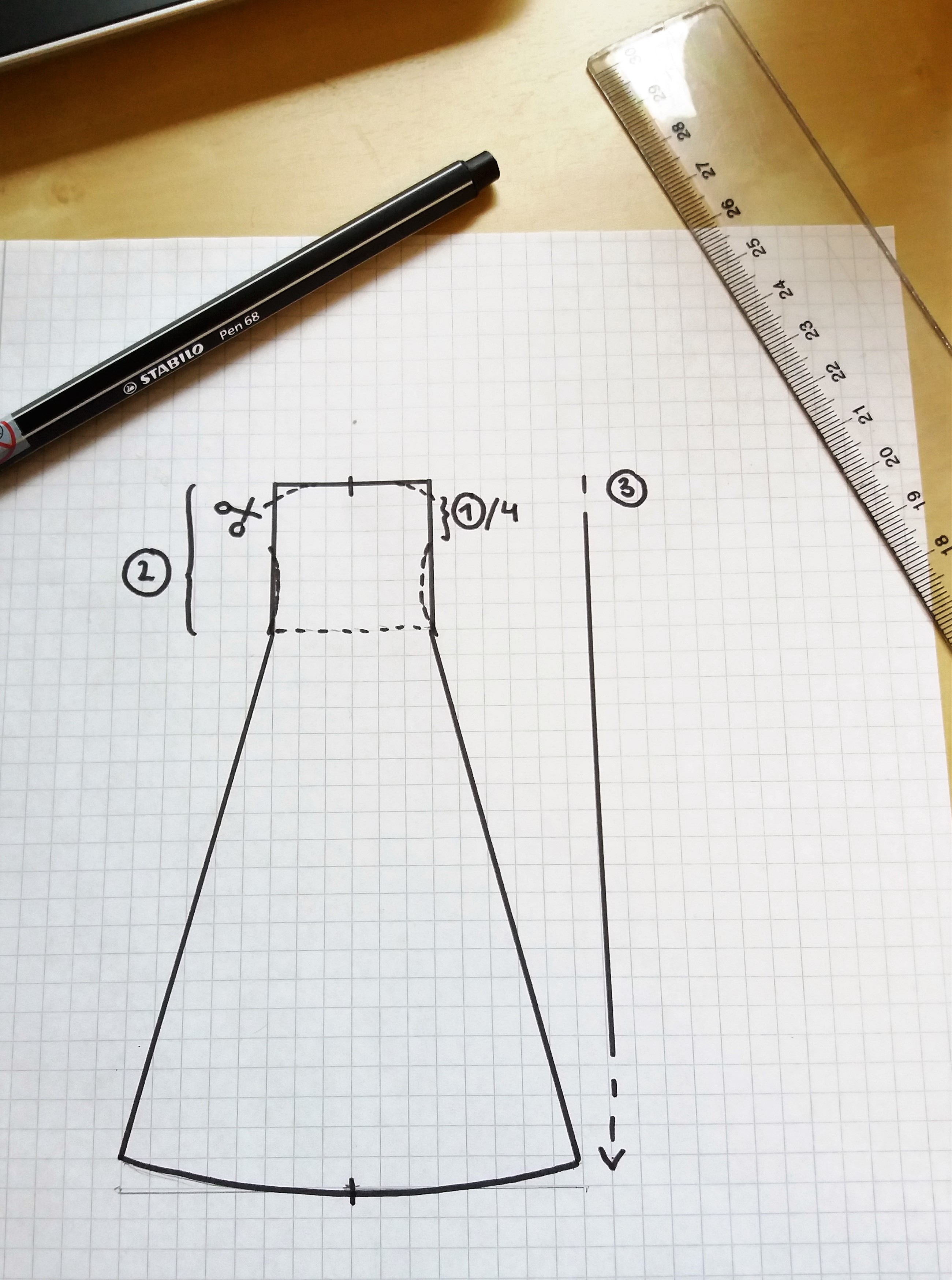
Armpit-hemd (3) (as long as you want the dress to be) + 3 cm sewing allowance at the bottom, and 5 cm at the top if you would like to make the dress with a higher look (like my green one) when measuring from the armpit; start as high up as you can get under the arm. you will cut out space for your arm movement later.
Width around your body (1) (the widest part of your body, often around your bust. Divide this measurement in 4 and then add 4cm to each piece (seam allowance and leisure of movement)
Armpit-waist (2) (in this case, your waist is your slimmest part of your body, after which the dress is going to get wider)
I chose to make my dress rather fitted, but a more loose style will make it possible to wear a pair of underdresses under it, which can be nice during colder weather. The 4 pieces are of the same size and shape. They start out straight and then gets wider at the waist.
The amount of fabric you need depends on your measurements, but I drafted up three different ways of putting your pattern pieces out on your fabric, depending on how much fabric you want to use.
For the draft to work you need to have a fabric that is 150 cm in width, and the dress can not be longer than that. 1F + 2F is the two side pieces, 3B + 4B is the front and back ones. The bottom-left draft shows how you can use the fabric in an effective way by doing a gore in one panel.
The upper pattern takes 250 cm of fabric and gives you a dress with a hem circumference of 80cm *4= 320 cm. You can absolutely do with less; the one at the bottom- right gives you a hem of about 270 cm, using under 200 cm of fabric. This is for a small-medium sized person. If you have a larger size, remember to add width not just to your upper area but to the skirt as well, to make the dress drape nicely and give you space to move.
After cutting the pieces from the fabric, baste them together in order to try the size and fitting. The dotted lines on the picture above indicate where you can fit the dress (waist+under the bust, under the armpit and at the small of your back). When you try out the dress, remember to have your shift underneath so it won’t get too small. If you’re using a modern bra during your viking adventures, then also wear it during fitting sessions.
When the dress is done, I usually make the straps in linen or wool fabric (linen straps are more common in finds). Make them as narrow bands (folded double) and sew them on to the back of your dress at the same position as your bra straps would be, this will make them fit comfortably on your shoulders. In the front, you may sew them down to the dress if you haven’t got tortoise brooches yet, otherwise use these to fasten the straps to the dress. I prefer to do a loop at the end of the strap, and then another one at the front of the dress; these you can clearly see in finds from the viking age, and it also makes it easier to use the brooches without damaging your fabric.
If you feel that you would like to add something; decorations are a nice way to spice up your apron dress. A tablet woven band, a small piece of silk fabric or a silver thread posament are all find-based decorations from the viking age. Good luck with your sewing!
I recently made (ok, rather recently…) this new green wool dress. It is an overdress for the 15th century outfit, and is commonly called a houppelande, which is like french for just ‘overdress’. The fabric is from Medeltidsmode, it’s a tabby woven fabric with a soft rich fall, and quite warm. The lining and the whole sleeves are lined with silk ( which is both fancy and in the case with the sleeves, very practical as the dress gets easier to take on and of) and the front is lined with a rabbit fur, that is from an animal/ecofriendly farm, and tanned with plants in an old-fashioned way. The dress is completely handsewn.
I wanted to show you this, because it’s a dress I’m very satisfied with, and also – I’m planning on a later tutorial about houppelandes and how to draft patterns for them. So, enjoy – here is a picture post about the green houppelande!
Great amounts of fabric gives you nice, deep and dramatic folds.
Under the houppelande I wear a blue silk dress, and rasberry-red shoes that I traded with Hans-Gunnar.
The belt is made of black leather and bronze fittings from a 15th century painting. The purse holder (to the right) is a way to be able to wear a purse in the belt- but I have not found that exact solution in any sources. It seem to be more common to carry your purse under the dress, in the belt of the kirtle. I had my Very-Fancy-Purse in the belt that day, but if you want to strive for a more historical accurate look- go without any visible purse.
Holding up the fabric is almost a must if you want to move around
Here you can see one of the gores I put in to save fabric, but expand the width.
The houppelande is a fancy dress, and should pool around your feet when you walk, if you don’t lift it of course! If you want to make one yourself- do it overly long. When I stand still, the dress arrange itself around me in deep folds.
Another thing is the width of the dress, and the amount of fabric it takes to do it. I had around 4 meters of 1,5 m width, but could definitely have used more fabric. As you can see, the dress gets very wide, and dramatic when hold up.
Are you interested in the viking age, but wonders how to learn more? Browsing pinterest on all lovely photos, but thinking that everything might not be historical? Here’s some really good links and reading for you! (And no, of course you don’t have to exercise your hobby the most historical way possible- but it’s always interesting to know-how)
Susanna Broome is a great tip if you want patterns and reading about pattern construction. Her page includes lots of good-to-know, as well as patterns for sale, both in english and swedish. She is both historical well-read, as well as daring to say “I did this, we don’t know if that is the correct way, but it´s working and gives you a nice outfit”.
Viking clothing (Thor Ewing) is a good read. Everything might not be historical accurate since he is making conclusions- but it makes the book interesting for reenactors and not just a list of different finds.
Pinterest is both very good, and quite dangerous. Lots of pretty clothes, lots of fantasy, lots of guesses. But also lots of finds and photos from museum and databases, good quality handcraft and historical interpretations. Look for Viking Finds rather than just “vikings”, archeological material, posts about what have been found and were, and pair it with written sources.
For viking finds of metal, ceramics and the like, different museums offers online databases. For example, I found one of the original tortoise brooches (that I use in my outfit) on the Västernorrlands Länsmuseum which is only a short trip from my home.
Good luck with your reading, and please write a comment if you have any more interesting reading tip to share!
During Hägnans Medeltidsdagar in Luleå this summer, (that the local SCA group Frostheim organized) I had the over all responsibility to make the handcraft camp work out well. We had a camp outside (or inside if the weather was bad) with different kinds of handcrafts that each participant brought (so you could do whatever was in your interest and current project, as well as trying out some new things others had.) My work was mostly about saying “yes, good job!” and checking that the guard schedule was working. And reminding people of lunch – lunch is important!
Basically, it’s not that much work – happy handcrafters of different kinds gather and sit down during the days to craft, talk and show different kinds of handicraft to interested visitors. I usually try to make them bring many different things to work with, and to show different stages in the handcrafting process so that visitors can grasp what it really is about. Good ways of doing this is showing step-to-step pictures or unfinished objects, talk about the handicraft, lay out your tools etc. People get really interested when handcrafting is actually done – my love even got attention for winding yarn by hand when he sat down and helped me…
I also brought my market shop with me; but as usual I’m just not that interested in selling things from a specific place, when there is an opportunity to go around, talking handicraft, taking photos, sewing on projects and drinking coffee. So my market stall was mostly empty (but my friends checked it for me – thanks!) Anyway, it is good to have the shop with me because it usually spread the costs and make me afford all the traveling expenses.
Johan and Erik from Trix were performing just behind us during the week- first class entertainment while you are sewing!
I really recommend visiting handcrafting areas if you are a visitor on a medieval/viking market. Bring a project, some snack or just questions about different handcrafts and you will be almost sure to find someone who is willing to share and talk about how things are done.
This apron dress is really simple and easy to sew together- perfect if you want to save fabric, try to hand stitch your first garment, or just want to try out a looser fit on an apron dress.
The description is based on the fact that you have a fabric that is approximately 150 cm wide, and the dress in the picture is about 130 cm long. If your fabric width is different, you will have to redraw the pattern pieces and probably piece the dress together with more gores. I show you a way to make the skirt fuller with a small gore on the drawing below. The method can be used for larger gores also. B = back of the dress, F = front.
Customize the measurements according to your own measurements. The amount of fabric you need depends on your measurements + how long you want the dress to be. On the pattern diagram, 1 square = 10 cm, so it takes 2.2m of fabric to make the dress to my measurements. Draw a separate paper sketch before you begin so you will understand how the pieces are laid out!
This description is mostly about the pattern-making assembly. If you want to know more about seams and techniques, check out my other descriptions and tips on the blog.
Start with calculating your measurements, and draw the pattern on paper. The dress consists of an entire front piece (F), and a two-piece back piece (B) that is laid out on the folded fabric. To get some extra fullness in the dress hem you can cut it according to the suggestion in the picture (the back piece is then cut in the bottom with a small gore).
Measure around the bust/widest part of your upper body = the measurements on the narrowest part of the dress: split the measure in two to make the front and back. Remember to add seam allowance; 1-2 cm on each side. The measures on the pattern are approximately 90 cm to fit me (40 cm on the front and 50 cm on the back piece). Because the dress does not start in the middle of the bust, but a bit above, you get enough space to move and dress/undress easily even if the measure is a little less than your widest circumference (I have 93 cm over my bust).
The length of the dress; measure from the armpit and as far down as you want the dress to go. Add seam allowance of about 4 cm. In the picture, the pieces are 130 cm long. The width of the dress hem becomes 2 * the total width of the fabric so 2 * 150 = 300 cm.
Once you have cut out your pieces; sew the back piece in the middle, then sew on gores if you made any. Bast the front and back together and try; cut out a little for the armpit if you want, and mark with pins where your straps should be attached (I usually like to wear them in the same position where I have my bra straps, I guess my shoulders are used to that.)
Sew the sides together, press and fold the seams, whip stitch them down to one side, and finish the hems by folding them once (on a thicker fabric) or twice (on a more lightweight fabric) and whipstitch them. Finish with sewing on thin fabric straps (I usually fold mine twice towards each other, whip stitch them together and then sew them on the garment. Then you are finished!
I really recommend buying a lightweight, more loosely woven fabric for this dress. Sturdier wools will not fall as nice and might feel like you are moving around inside a tent-like garment…
Åh, äntligen en ny tutorial! Efter att tredje vännen frågat hur jag gjort min nya hängselkjol (som inte är så ny längre, den är nästan två år) så fick jag äntligen energi till att göra den här beskrivningen. Konstruktionen är verkligen superenkel, bekväm och tygeffektiv. Perfekt till dig som vill spara tyg, sy för hand eller bara göra en lösare hängselkjol.
Beskrivningen bygger på att du har ett tyg som är ca 150 cm brett, och kjolen på bilden blir ca 130 cm lång. Anpassa måtten efter dina egna mått. Tygmängden som går åt beror på dina mått + hur lång kjol du vill ha. På bilden är 1 ruta = 10 cm, så det går alltså åt 2,2 m tyg till mina mått. Rita ut en egen skiss på rutat papper innan du börjar så kommer du förstå hur bitarna hänger ihop!
Den här beskrivningen utgår mest från den mönstertekniska hopsättningen- om du vill veta mer om sömmar och tekniker kan du kika på mina andra beskrivningar och sytips här på bloggen =)
Räkna först ut dina mått, och rita upp mönstret på rutat papper. Hängselkjolen består av ett helt framstycke, och ett tvådelat bakstycke som läggs ut lite omlott på dubbelvikt tyg. För att få lite extra vidd i kjolen så kan du skarva den enligt förslaget på bilden (bakstycket är alltså skarvat i nederkant med en liten kil).
Mått runt bysten/bredaste delen av bröstkorgen=måttet på kilens smalaste del: dela i två och fördela på bak och framstycke. Kom ihåg att lägga till sömsmån. På bilden är måttet ca 90 cm (40 cm på framstycket och 50 cm på bakstycket). Eftersom hängselkjolen inte börjar mitt på bysten, utan en bit ovanför, får du vidd nog till att röra dig och ta på/av kjolen enkelt.
Längd på kjolen; mät från armhålan och så långt ned du vill att kjolen ska gå. Lägg till sömsmån på ca 4 cm. På bilden är styckena 130 cm långa.
Kjolfållens vidd blir 2*tygets totala bredd så 2*150=300 cm.
När du har klippt ut dina bitar så kan du först skarva bakstycket mitt i, sedan sy på ev kilar i nederkanten. Tråckla ihop fram och bakstycket med varandra och prova; klipp ur lite för armhålan om du vill och markera var hängslen ska fästas.
Sy ihop sidorna, fäll sömmarna och fålla alla kanter. Avsluta med att sy på hängslen- klart!
So, I was originally going to write a detailed post about my preps for Visby. I’ve been packing, planning, sewing, making tutorials for sale and much more. Buuut everything went according to plan, I finished mostly everything yesterday, and today my preps is all about chilling, picking berries in the garden, training my horse and having a barbecue with my friends J and L whom I am traveling and living with. Feeling really relaxed and looking forward to this week!
Tomorrow early morning we leave for the ferry, and then I am at Visby the whole week! If you are reading my blog; I would love it if you said Hi! during the week, or stopped by for a small chat. It’s so nice to meet all of you readers and get a face on all the stats… And if you really likes the free tutorials and stuff and meet me during the week- I really like wine. Just saying…
Special tip: Have you noticed that my Instagram now also have a guest player by #GladaRåttan? Glada Råttan (Happy Rat) is a small pop-up store, that will appear on the marketplace by Friday evening, near the open space were Forum Vulgaris usually is. If you are an (more or less) adult and like (more or less) bawdy and sex-related stuff, this shop will be just in your taste…
Wow- look at this! Now my guide is out in English to; thanks to Riia who translated it because I didn’t have the time.
Why should you go to Medieval Week in Visby?
Because it is a delightful, lovely, and inspiring medieval festival, perfectly suited for those
who love fantasy, tales, and the Middle Ages, both for young and old, tourists and the genuine
thing. You dedicated re-enactors travel with the understanding at it is ever so much more fun
to share in the magic with thousands of tourists.
Where will you stay?
If you have medieval camp equipment: in Stryingheim’s SCA tent camp, just outside of the
city walls. In addition to being a secure camp with guards, food, good logistics, and near to
the old city, it is also a wonderful way to find a Medieval organization near you, meet new
friends and learn more about medieval crafts, fighting, archery, and cooking. SCAdians are
known to share freely both their knowledge and friendship—I think that it is the best place to
hang out, and the location of the best parties.
If you have a modern tent or travel for the relaxed medieval experience: Medieval week’s
damping (which has two separate parts) has a reputation for being a nice campground, and
one needn’t hide one’s milk cartons and grocery bags as one must in the SCA camp, where
one does one’s best to maintain the illusion of the best parts of the Middle Ages 24 hours a
day.
Or rent a room—it can be a little spendy, but absolutely more personal than a hotel room!
Free time at Kapitelhusgården, I like it best there during the afternoon
Where will you eat?
I, as both a vegetarian and allergic, am rarely impressed by pub or restaurant offerings. I can
usually find a little salad, some Thai, a taco plate at Yoda (here they are not stingy with the
plates), and can relax at the “Munkkällaren”, in addition to the Medieval Resturant. The Visby
Ice Cream shop (Wisby glass), sells the best fresh ice cream and the cheese shop (Wisby ost)
sells the best luxury snacks and a really good gluten-free bread.
There are also some gems with good food in the Visby city center, and some that carry tasty
food late in evening (go where the locals go!), but the best option is to buy some picnic foods
from a grocery store outside the city walls. Fill a large basket of bread, fruit, cheese, sausage,
and something to drink, complete with a fresh carrots and raspberries from the large market.
Take it all to the beach, grassy lawns by the market place, or to a free concert and enjoy the
world’s cosiest picnic. You do know that picnics can be eaten at least three times a day? PS
extra chocolate and strawberries will attract new friends.
The Fire show and picnic go very well together.
Which activities are the best?
Medieval week begins already during the voyage over; take along a snack and something to
sew on, and you will fit in perfectly with all of the other happy medieval people who are
panic-sewing the last bits of their costumes. To sew on the ferry over is a well-established
tradition. On the return trip one doesn’t sew; one sleeps, and curses all of the parents who let
their children run wild.
The best place to relax and see entertainment is the Forum Vulgaris, at the market place,
which has been run by Proknekt for several years. Check out also the Medieval Week events
program to find such treats as open performances, dance and other workshops which occur
here and there within the city walls.
If you like the German fashions from the 1500’s then the “100 knectars” march is a must-see
cool experience. Drums and music echoes through the streets of Visby and the vibrations from
hundreds of feed can be felt through your entire body when they march through the town. Join
them!
Kapitelhusgården is the location where I, and several other talented craftspeople teach courses
and give lectures over the week, so come by and learn a new craft technique! Many have held
their courses for several years and are real professionals who are outstanding in their field,
and here you have the chance to go to classes you would otherwise need to travel across half
of Sweden to attend.
Picnics in conjunction with the concerts, or in line for performances, and as a celebration after
performances, are cosy.
The Medieval garage sale is really fun, and is truly what it sounds like, but others have
discovered it, so be prepared to come early, and stand in line.
The Folksagosånger performance with David and Karro I will try to get to- when last I
listened to the duo they were good, witty, and had a wonderful atmosphere.
The prettiest places:
The botanical garden is one of my favourite places during the day: a beautiful garden with
nice benches and happy people strolling past. The little market at Kapitelhusgården and a
glass to drink in the afternoon before it becomes crowded. Beach walks during sunset, the
Trix fire show on Wednesday evening (go there for the atmosphere as much as the
performance), and the old city with in the city walls, with all of the narrow streets and
beautiful roses which climb along the house fronts. Magic!
Outside of Visby there is a pretty countryside on the road to the sea-stack Jungfru and the blue
lagoon, an old limestone quarry which provides clear and warm swimming water, well worth
the day’s excursion.
How long should I stay?
The whole week, at least! The town is Medieval from Saturday till the following week’s
Sunday, and if you want to see more of Gotland, you perhaps will need a few extra days. I can
never understand how a week can go by so quickly, and I never manage to see and do
everything I had planned. On the other hand, I am a confirmed Medieval nerd, and besides I
do work half the week. In recent years it has taken me several days before I even managed to see the whole market…
Think about:
It can be really bone-chilling cold in the evenings—take along a warm cloak (or jacket or
sweater).
It is good to bring along a pack of re-hydration tablets to mix with drinking water during the
heat of the day when you have walked too much. Bring also a large bottle to carry water; you
can fill it at water faucets in the market.
Visby’s streets are mostly cobblestone or asphalt, take along really comfortable shoes so that
your knees don’t complain after half a week.
Elin som driver Nevnarien.se gjorde en sådan himla fin guide till Medeltidsveckan i Visby, så jag blev inspirerad att skriva min egen. Elin älskar sagovärlden, schysst stämning och snygga fotomiljöer, och kanske märks det i hennes guide? Vad jag är insnöad på, det får ni veta här…
(this post is only in Swedish, and is a guide for the medieval week in Visby. Are you going? Use google translate to get some good tip about places to go!)
Varför ska du åka till medeltidsveckan?
För att det är en glad, kärleksfylld och inspirerande festival med medeltidstema. Passar både dig som gillar fantasy, sagor och medeltid; gammal som ung, turistig eller genuin. Du som är inbiten reenactare åker med inställningen att du kommer behöva dela allt magiskt med tusentals turister- men ju fler desto roligare?
Var ska du bo?
Om du har medeltida läger; I Styringheims SCAläger utanför murarna. Förutom att det är ett tryggt läger med vakter, mat, god logistik och nära till innerstan är det ett superbra sätt att hitta en medeltidsförening nära dig, träffa nya vänner och lära dig mer om medeltida hantverk, kämpalek, bågskytte och matlagning. SCAiter är kända för att strössla fritt med både kunskap och vänskap- bästa hänget, och bästa festerna händer här tycker jag.
Om du har ett modernt tält eller åker för att medeltidshänga avslappnat: Medeltidsveckans camping (som har två olika delar) har rykte om sig att vara en trevlig camping, och här behöver du inte gömma filpaket och icapåse vilket uppmuntras till i SCAlägret- där man gör sitt bästa för att hålla en illusion av den goda medeltiden under dygnets alla timmar.
Eller hyr privat- det kan bli lite av varje men definitivt mer personligt än ett hotellrum!
Var ska du äta?
Jag som är både vegetarian och allergisk blir sällan imponerad av krog eller restaurangutbud. Det brukar bli lite sallader, lite thai, en taccotallrik på Yoda (här snålas inte på tallriken) och häng på Munkkällaren, förutom de medeltida restaurangerna. Wisby glass säljer den bästa färska glassen, och Wisby ost (liten delikatessbutik) har bästa lyxsnacksen och superbra glutenfritt bröd.
Det finns alltså några guldkorn med bra mat inne i Visby stad, och några hak som lastar på smaskig mat sent på kvällen (gå dit ortsborna går!) men det bästa hänget får du genom att köpa med dig picknickmat från någon av mataffärerna utanför ringmuren. Bunkra upp en stor korg full av bröd, frukt, ost, korv och dryck och komplettera med pinfärska morötter och hallon från stora marknaden. Ta med allt till strandpromenaden, gräsytorna på marknadsplatsen eller en gratis spelning och få världen mysigaste picknick. Ni vet väl att picknick kan ätas minst tre gånger om dagen? Ps; extra choklad och jordgubbar lockar till sig nya vänner.
Eldshow och picknick. Passar ihop
Vilka aktiviteter är bäst?
Medeltidsveckan börjar redan på färjan över; ta med fika och något att sy på så kommer du passa in som en smäck bland alla glada medeltidsmänniskor som paniksyr in i det sista. Att sy på färjan över är liksom en tradition. På färjan hem syr du inte. Då sover du. Och förbannar alla barnföräldrar som släpper sina monster fria att härja som de vill.
Forum Vulgaris på marknadsplatsen har drivits av Proknekt under flera år, bästa stället att hänga på för att få se föreställningar. Spana också in programmet för att hitta små godbitar i form av öppna spelningar, dans och workshops som händer runt om i innerstaden.
Om man gillar det tyska 1500talsmodet så är 100 knektars marsch också ett måste- ja, för alla som gillar coola upplevelser! Trummor och musik ekar genom Visbys gator och vibrationerna från hundratals fötter känns i hela kroppen när över 100 knektar tågar genom staden. Gå med du också!
På Kapitelhusgården håller jag, och flera andra skickliga hantverkare kurser och föreläsningar under veckan; så kom förbi och lär dig helt nya hantverkstekniker! Många har hållit kurser i flera år, är riktiga proffs och framstående inom sina områden, så här finns möjlighet att gå på kurser du annars hade behövt resa runt halva Sverige för att få tillgång till.
Picknickhäng i samband med spelningar, köande till spelningar och som fest efter spelningar är mysigt.
Medeltidsloppisen är jätterolig och verkligen vad den låter som- men fler har upptäckt den så var beredd på att komma tidigt och köa!
Folksagosånger med David och Karro ska jag försöka pricka in; senast vi lyssnade på duon så var det både stämningsfullt, bra och underfundigt roligt.
Vackraste platserna:
Botaniska trädgården är ett av mina favoritställen under dagarna; vacker trädgård, fina bänkar och glada människor som strosar förbi. Kapitelhusgårdens lilla marknad + ett glas dryck under eftermiddagen innan det blir trångt här. Strandpromenaden under solnedgången, Trixs eldshow under onsdagskvällen (gå dit för stämningen lika mycket som för showen) och Visby innerstad med alla trånga gränder och vackra rosor som klättrar längs husfasaderna. Magiskt!
Utanför Visby finns vacker landsbygd på väg till rauken Jungfrun och Blå Lagunen, ett kalkstensbrott som bjuder på klart och varmt badvatten. Väl värt en dagsutflykt.
Hur lång semester?
Hela veckan, minst! Medeltid är det från lördag till nästa veckas söndag, och vill du ser mer av Gotland så kanske du behöver några dagar till. Jag kan aldrig fatta att en vecka kan gå så fort, och hinner aldrig se och göra allt jag har tänkt mig. Å andra sidan är jag ju en inbiten medeltidsnörd, och jobbar dessutom halva veckan. De senaste åren har det tagit mig några dagar att ens hinna mingla ned till marknaden…
Tänk på:
Det kan bli riktigt råkallt på kvällarna- ta med en varm mantel (eller jacka/tjocktröja).
Ett paket vätskeersättning, att blanda i dricksvattnet under varma dagar när du promenerar mycket, är bra att ta med. Ta också med en stor flaska att ha vatten i, fyller på gör du vid vattenstationerna på marknaden.
Visbys gator består till stor del av kullersten eller asfalt- ta med riktigt sköna skor att gå i så knäna inte klagar efter halva veckan.