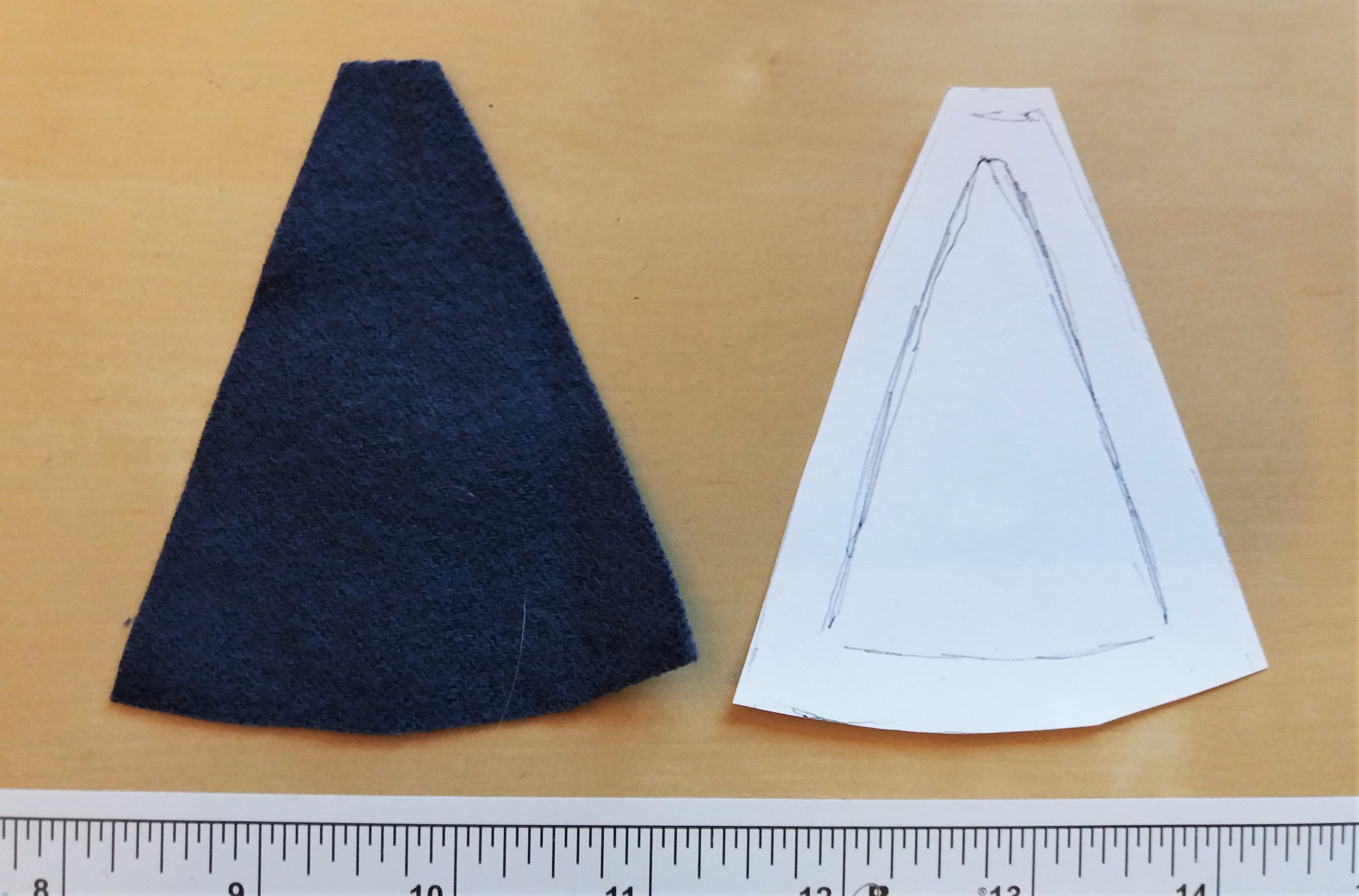
I made love a new pair of summer hose, in really thin wool twill. The hose got some though love during the summer and come autumn the soles looked like this:
Not much left. When your soles are this worn, it is easier to just change them for a new pair. This round, I choose a thicker and more sturdy wool twill, hoping they would last more than one summer. I ripped the old soles out, and traced around them on a new piece of pre-washed fabric.
Tracing the old soles to new fabric. Remember to add seam allowance if that is worn away.
The top fabric was in pretty good condition, but worn thin in some places. I reinforced those spots with patches on the inside, sewn with running stitches and wool thread.
Soft fabric and a thin wool thread will make the mended areas comfortable. This is the right side of the hose.
All worn areas mended; horizontal and vertical running stitches to secure the patches to the hose, and backstitched soles in place. I did not bother felling the seams, I predict these will soon need to be ripped again…
Heh, see what I did there? Pattens- step to step, as you can step with them and this is also a guide and…
Yeah. Sorry, let us step to the actual content.
15th-century style pattens
I had been trying to get myself a really good pair of wooden pattens for a couple of years, only to discover that they didn’t fit very well. So I got my hands on a new pair of wooden soles, and this time I made the straps and fitted them myself. It is a little more work than ready-made, but Wow did this make all the difference!
This project was started over 3 years ago and along the way, I lost photos from the handcrafting process. This means that this tutorial is far from the best one I have made, but I decided to finish and publish it since some friends were asking for tips for making pattens.
If you want to know more about historical pattens, check out this blog post.
Good things to make medieval pattens.
Tools for this project:
hammer
scissor
pen
knife
ruler
awl
needle
leather clips
Materials you need:
wooden soles
thick leather 2,5-4 mm
thin leather 1-2 mm
waxed linen thread
nails
tape and regular paper
two buckles around 1-1,4 cm width (optional)
Wooden soles:
You need a pair of wooden soles first, and your medieval shoes. Measure your foot with your shoes on, so you know how long the wooden sole needs to be. I didn’t make my wooden soles so I won’t walk you through (hehe, walk…) how to do it, but if you have patience and a few woodworking tools just draw your foot on a piece of wood, and carve out something that looks like the historical pattens or my sole above. The joint is not a must but I find it really comfortable.
When you have a pair of wooden soles, it is time to connect the pieces with a joint of sturdy leather and nails.
Use a paper draft to fit in the joint, mark it and copy to leather. The leather should be as thick as the cut-out for the joint, between 2,5-4 mm.
Hammer the leather joint in place with nails, and then start working on your strap. Paper and some tape is a good way to test out the pattern and fit.
My goal was to make a strap that both looked plausible and was comfortable. I started by attaching my foot to the wooden sole with tape and then tried to move around. This was not the right fit.
But it was a good starting point to achieve something like this! I cut away the tape that was uncomfortable or in the way, until I got a fit that was working. Last, I taped the buckle in place to check the fit. Try to position the tape quite high on your foot, not over your toes.
When you are happy, cut off the tape and convert them to two pattern pieces, one for each side of the foot.
Next step is to cut them out in thin leather, 2 of each.
Thin leather needs some kind of reinforcement to last, so cut out strips of leather to sew on the edges.
Use an awl to make holes in the leather before stitching. Note that the strip should reach all the way up, this was just a test piece I made before doing my finished set.
Use a cobbler stitch and waxed linen thread to sew the leather strip in place.
Turn the piece to the inside, fold over the leather strip and sew it in place with a whip stitch. Don’t work through the leather piece, just enough to fasten the strip. To shape the edge and make it stay in place, you can hammer it down gently.
One piece is almost done, one to go. This was my finished pair, note how the strip goes all the way up and it is really narrow at the top to accommodate for the buckle.
After I made the reinforced pieces, I attached the buckle by sewing it in place, and made a hole in the other side for closing.
Trying out the fit of the finished pieces, by using a stapler to fasten the leather to the sole. You can also use some more tape. Love tape.
Hammering the leather in place with small nails. These are modern nails for roofing paper, but you can use any flat, shorter nails. It would be pretty to use historical nails, but I did not find any narrow enough.
That’s it! Give them some leather oil and then you are ready to go out adventuring.
Trying them outside in some water and grit.
There are lots of sources without buckles on your pattens. It is possible to just make a plain or decorated leather piece around the foot. The best part with buckles is not that they are pretty, but that you may adjust the fit to the shoes (or hose without shoes) that you are wearing.
If you know me, you know I am travelling and living my medieval/viking adventure life right now, and both blog and social media conversations are running low. If you are new- welcome here! I will not leave you bored in the middle of the event season, but have prepared some interesting posts for you to check out.
Last year at Visby; only a week left now!
The best way to reach me right now is by email. I also try to keep Instagram updated, but rarely use Facebook since it doesn’t work great on the phone. https://linktr.ee/handcraftedhistory for more ways to reach me!
If you are attending Medeltidsveckan in Visby, you can find me at Kapitelhusgården from Sunday to Sunday. The shop is open, and I also have workshops in pattern drafting and tablet weaving. These are currently fully booked, but you can check out the full schedule here: https://medeltidsveckan.se/programme/
Last years pattern drafting (sleeves)
Are you attending one of my workshops and have questions? Send me an email! The info at the program states if you need anything special (like a modern t-shirt or similar clothes on your body for the pattern making) othervise you can just stroll in with a snack and a ticket- I will bring everything else!
If you want to check out more about Medeltidsveckan I have written about past adventures here; https://handcraftedhistory.blog/?s=visby where you also find the old guide and the packing list in Swedish.
In my shop you will find lots of straw hats and felted wool hats- but be sure to come by early in the week to secure the colour/size you want. Last year they sold out. For you readers interested in straw and wool hats but not attending Medeltidsveckan- I will open up my Etsy store and start accepting commissions when I am back home and can start packing and shipping regularly again. Thank you for your patience! (Yes- I remember you who have emailed/pm/contacted me)
At Kapitelhusgården
New blog posts, patterns and research articles will be coming again this autumn- I look forward to share new and interesting stuff with you! With that said, I will continue with my packing/working/panic sewing days. Yes, I also have late projects. Yes, I will also sew on the ferry over… It is tradition, is it not?
I could call myself somewhat of a pro at living in historical tents, or more accurately, sleeping bad and freezing in historical tents… Therefore, I present to you a guide on how to choose your tent and live comfortable in that!
(This turned out to be a really long blog post- I have apparently missed talking to you. I marked all my personal thoughts and anecdotes with cursive, for easier reading)
Which period?
Different models are based on finds from different periods, so if you are going on viking adventures the Geteld or A-frame models are most often used. For medieval adventures, Getelds and Pavilions are good choices. Small shelters called “Soldier’s tents” are also often used.
When looking at websites selling tents, many will show you models that are not based on finds or pictures but called “historical” anyway. The openings could be placed in new ways, the seams made to save fabric widths or moved to be able to sew on a machine. The poles and ropes holding the tent up might be done in different ways that can not be seen in manuscripts and so on… These tents may still be good tents, but it is always good to know what you buy, and what it is based on for the future. If you are unsure about a model, ask!
A-frame tents at a viking market
What says finds and historical pictures?
Viking type tents are based on ship burials which have included a tent with a wooden frame and canvas. We don’t really know if people actually slept in these on land as well, and they probably did not bring them to different markets all summer… But what to do, when you are a modern person wanting some comfortable living?
Medieval type tents are seen in numerous manuscripts and paintings, both used by nobility and commoners. Brightly painted, large tents are used for festivities, tournaments and for avoiding that pesky sun, while small sleeping tents and shelters can be seen in military settings. A quick search gave me this board.
Round pavilions at Double Wars.
Where are you going?
Many events have lists or recommendations about what tent models are allowed on their events. Mostly, you can bring Getelds and A-frames to viking events, as well as small canvas pieces as simple roofs. To medieval events, Getelds are often allowed, as well as square, round and oval-shaped Pavilions. Materials may also be advised to be linen or wool.
Sleeping tent in the middle, and large pavilions in the background.
The event organizer will want to have as pretty a camp as possible, but at the same time, they know tents are really expensive and that guests will stay at home if their living investment is not allowed. The same is true with market tents; most of them are not strictly historical since a modern seller will need light loads to carry and transport, as well as a big enough tent to be able to bring enough products to earn a living. Not everyone can sell jewellery and candy, so some will need big, bright and roomy tents.
Other things to consider are the campgrounds; is it rocky and hard to put down tent pegs? Then an A-frame tent might be good. Is it often stormy and windy, then perhaps a smaller tent with a sturdy frame and long tent pegs is a good choice. Have you ever seen a jumping A-frame tent in a storm? I have, they can really get quite far…
Cotton, linen or wool?
Cotton is by far the most common tent canvas today since it is cheaper, lighter and easy to come by in the right thickness and waterproofing. I use cotton in my Pavilion to be able to lift the canvas pieces myself and to have a tent that is bright enough for customers to see my products, even if it is rainy outside. But oooh, my old linen pavilion was prettier!
Linen is heavier but more resistant to mold, and unbleached linen will keep your tent cooler and darker. Perfect for sleeping in, not so good if you are a market vendor selling fabrics. Linen gets bleached over time in the sun, giving the canvas a really good look.
Wool is mostly used in A-frames and a good, felted wool fabric will keep you dry, cool and comfortable in all kinds of weather. May be waterproofed with modern products, or with lanolin (wool fat) which is more historical.
Different types of fabrics; brown wool tent, white cotton tents and the unbleached linen pavilion in the background.
Consider this when choosing your model:
Packing space available (how much space do you have in your car for a tent canvas and wooden frame?)
Storing space (where will you keep the tent off season?)
How many people and how much stuff do you need to fit?
Is it important that you can put up the tent fast?
Is it important that the tent is easy to lift/carry? (consider a canvas in several pieces)
Should the door be big (welcoming/good shop) or small at one edge (more sleeping space)?
I have always been partial towards Geteld models since they are often economical, easy to transport and fast to put up and down.
With that said, after living for weeks in this model you will get really tired of the sloping walls, giving you almost no space to hang clothes for drying (except in the middle). Storing all your things around the base of the tent will save lots of space to allow you to walk around in the middle, but it will also mean you crawling around on your knees looking for things every day.
A-frame tents also seem very practical and I am slightly jealous of my friends when we are putting up camp at rocky, hard grounds. While I am sweating and swearing trying to put down the tent pegs in the ground, they simply fold their tent in place, secure the canvas by the frame and move in. I usually get my revenge when the carrying distance between car and camp is long since I can carry my poles in one go…
A-frame tents are practical, economical and if you have the storage and packing space for the frame it is a good choice. It is also considered the easiest tent to make yourself.
Pavilions often have a roof with separate walls, allowing you to open up different sections of the tent if you want the breeze to get in, or want a nice display area. Straighter walls with poles or wooden wheels mean you can place furniture along the walls, and hang clothing from the wooden frame, which is both practical and pretty. More sloping walls on the other hand might ride out storms better.
Round and square pavilions may be sensitive to hard winds and storms; during the Medieval Week in Visby you may see knocked down tents of these models, or tents laid down by choice before a storm. If the round pavilion has a sturdy roof frame, you can remove the middle pole, fold the walls and secure the roof down to the ground covering all your furniture and belongings while you wait for the storm to pass. You might not fit inside, but your tent will survive…
If you only want a sleeping place, tents called “soldier’s tent” or one-man tents might be the right choice for you. I would advise you to get a tent big enough to fit a bed inside, then you will always have a dry space, and can store your things under the bed.
Will I get wet?
A good tent will keep you dry even in heavy rains, as long as you can stay of the ground (in a folded camp bed or wooden bed for example). Also, never put clothes or bedding up close to the canvas, ideally, nothing should touch the canvas walls except the framework.
Our oval pavilions have kept out heavy rains on several occasions, with the single drop or two from a slacking corner joint between roof and wall. During one event, the rain was so heavy that small runlets formed and travelled through the tent. Everything above ground kept dry, but a turn shoe almost floated away…
Look for a tent construction that has sloping roof/walls, and a canvas that is thick, sturdy and treated with a waterproofing agent. Even so, after some years out and about the canvas may need to get additional waterproofing.
How to care for a historical tent:
Let’s start at the beginning; oil all your wooden poles upon arrival, and once a year after that (or when needed). When you put up your tent; find the right way to do so without adding unnecessary tension to the pole, canvas or ropes. The same goes for taking down the tent; do so slowly and controlled, and get some friends to help you in the beginning. Always mend loose ropes, or broken seams at once. Make sure the tent canvas is really dry before folding it away in the storage, and that it is reasonably clean since rotting mud, grass and insects may cause damage to the canvas over time. Brushing away loose bits before folding the tent is good. I also brush off the dirt from the tent pegs and ropes. The canvas should be stored in a dry space, outdoor sheds are not ideally. I can give you several examples of people having their tents destroyed by mold and rats during winter…
More tips to be comfortable in the tent:
Furniture like a bed, table and chairs (so you don’t have to sleep and sit on damp ground)
A heater for those chilly events (if you live in an area with cold nights and rains). We have a portable gasoline radiator (the same type you might have in a trailer van).
A mosquito net to drape over the bed at night
Look for opportunities to hang things inside the tent; a lantern and a rope for drying clothes make life easier.
Things to ask (or look for) when buying a tent:
What material is the canvas made of, and is it waterproof? Treated to withstand mold? Treated to slow fire down?
How much does the canvas weight? Does it come in 1 or several pieces?
How long are the frame/tent poles?
Are rope and tent pegs be included?
How should you take care of the tent?
If the tent canvas breaks, is it possible to buy additional fabric for mending?
Pricing?
Historical tents are expensive. Or at least, there is lots of money involved. The cheapest way is often to make one yourself if you have the time, space and skill. The second-hand market is also a really good choice, when people get tired of their small, practical tents and want to level up, they will often sell them for a good price. But try to inspect the tent yourself before you pay for it (ideally put up) to avoid bad canvas, mold, rips or a cracked frame.
A short sneek view over the camping ground at Double Wars; here you can see many different kinds of tents!
Welcome! Today I’ll show you some of my favourites from my historical wardrobe and give you my best advise on what to choose for your own outfit. Let’s start with veils.
My current favourite is the semicircle veil in different sizes. It is easy to drape and style, and the semicircle cut gives it a smooth and flowing drape. Here are some examples:
large semicircle veil
medium veil from behind
The measures on my different veils:
small: diameter 85 cm (the straight front edge) length 55 cm (from front head to the back).
medium: diameter 100 cm, lenght 58 cm.
large: diameter 140 cm, lenght 60 cm.
small semicircle veil
This is a larger semicircle veil in wool muslin fabric, worn over braids, cap and wimple. Pinned in place by the temples and in the back of the neck:
winter wool veil
To make one: Use a thin tabby linen (90-120 gram/m2) with an even weave. Presoak and wash before sewing to avoid shrinking in the future. I draw the measures directly on the fabric; a semicircle shape following the measures above. The reason for not making a mathematical semicircle is more a matter of taste; how long you want the front edge to be and how much fabric you want in the back. Try it out and see what you like!
I make small double folded edges and whip stitch them with silk sewing thread or 60/2 thin linen thread, vaxed before sewing.
The rectangular veil is a very useful veil that can be worn in several ways. It has a straighter fall than the semicircle, but is ideal for wrapping or draping around the neck, like this:
rectangular veil
rectangular veil with decorative edge
If you make the rectangular veil longer it becomes what I call a Great veil:
great veil for wrapping
The great veil above measures 55*250 cm and is great for creating turban styles seen in the 15th century.
The measures of some of my veils:
Simple rectangular veil: 55*150 cm
Veil with a decorative edge in linen: 50*150 cm
Great veil: 50*250 to 55*350 cm
Use the same quality linen fabric as above, and the same seams.
Shorter Great veil (200-250 cm) worn wrapped around the head, the end folded over the head and resting on top.
When sewing veils for wrapping, I find it easier to use them if they are not to wide. 50-55 cm is enough.
silk veil
Square veils are the hardest to style in my opinion. This model was the first I tried out, but we never made a great team. I do have one left though; my silk veil with freshwater pearls. Silk veils are high status veils, and look great. They are also very light, so you barely feel them on your head.
If you want to make a silk veil for yourself, use a fabric with a heavy drape and thin enough to be a little transparent. Sew the edges double folded with running stitches or even better; make a rolled hem with invisible stitches. (Or buy one ready-made from me with an email/pm).
Measures for a square veil: 80*80 cm or bigger (the silk one above is around 90*90 cm.)
This style is actually two or three different pieces: a cap with a folded strip of fabric pinned on, and a great veil on top. It is a simplification of the large head dress the fashionable woman wore during a preiod of the 15th century. Painting shows headwear with many folds or layers, held in place with pins, basting (or some kind of magic). But since I live in a tent during summer events (and not a comfortable house with a maid) I need simplified ways to dress myself. This was one option that came out nicely, it is both easy to pack and manage during medieval camping, and easy to dress myself in. It should be more tightly pulled in the neck though- contemporary pictures shows no such fabric volume in the neck.
simple style turban
This is another way to style the Great veil, for that “I am hard working but yet fashionable” look. The veil is pinned directly around the head without any shaping braids, padding or cap, and wrapped around the head a couple of times. It is then pinned down to the layers below, and the end left hanging.
To avoid bulky fabric in the neck, I have found that it is better to pin all models of veils in place instead of tying them.
Veil measures: 55*250 cm, thin linen with double folded edges.
Buying fabrics for veils?
Thin linen 90-120 g/m2 with an even weave, a semitransparent and drapey silk, or a fine wool muslin fabric are the materials used above. There’s no find of wool veils, but I use the fabric when I need to stay warm, and for its beautiful colour tone and drape. It is hard to find linen good enough for veils today.
Threads: I use 60/2 thin linen thread for linen veils, and silk sewing thread for wool and silk veils.
Type of stitch: Hand stitching is a good choice for veils since they are very visible, and the drape will look very different with a machine seam. I always fold the hem twice, as narrow as I can before sewing. Whipstitching is always a good choice, but running stitching will do the work faster and create a more discreet seam. Perfect if you have a very thin fabric, or are in a hurry. Silk fabric edges I like to roll and sew with an invisble seam.
variations; linen rectangle worn double folded.
You can vary your veils in many different styles to fit different periods, fashion and status. Above is the rectangular veil with a decorative edge, folded twice and pinned onto a birgitta cap.
The best way to find your styles is to look at contemporary paintings and portraits and try to replicate the look in front of the mirror. When satisfied- take some photos to remember how you did it. I always end up in early spring wondering what veil style I should wear for which outfit…
In this tutorial, a gore is a triangular-shaped piece of fabric sewn into the garment. A gusset is a square piece of fabric, sewn into the armpit to add movability and space, used on shifts and shirts to take a few examples.
How do they work?
A gore inserted in your sleeve will add space and freedom of movement. Depending on the placement of the gore in the sleeve, it will add space to different effects, like moving your arm up and forward or adjusting your sleeve to larger muscles in your arms.
Why do you want to use gores in sleeves?
Gores might have several reasons to be where they are:
To save fabric while cutting out your fabric pieces.
To add movability by cutting the gore on another grain than the rest of the sleeve.
To mend a broken sleeve or seam.
To enlargen a sleeve being to narrow.
Gores might be inserted while making your garment, but also afterwards if you feel a need to adjust the fit. This guide shows you how to put in a gore in a cut slit at the front of the sleeve, but you can also add gores to the seam on an S-shaped sleeve. The principle is the same; fitting the sleeve into the armhole and then adding as much gore as you need to make the sleeve ”whole”.
An example of how this method was used during the medieval period is the Moy Bog dress, which has a similar gore. Maybe an adjustment to add space to a new wearer that had more mass over arms and shoulders?
The easiest way to make well-fitted sleeve gores is to cut out a piece of fabric, pin/baste it on the inside of the assembled garment, and sew it in place. Here is a step to step guide on how I do:
14th-15th c short sleeved dress
This dress has a tight fit, and I decided on a small gore in the sleeve front to add a bit more flexibility and movement.
I started with inserting the sleeve in the armhole and then cutting up a slit in the front to make the sleeve fit all around (this means you will have to make a sleeve that has a slightly smaller measure than the armhole if you make a new dress.) When I am satisfied with the inserted sleeve and slit, I press the seam allowance to the inside and start with the pattern for the gore.
Put a piece of paper on the inside of the dress, and smooth the fabric on top of this. Draw a paper draft for the gore by tracing the ”hole” on your paper. Very easy!
Add seam allowance around the draft, and cut out.
Put the paper pattern onto fabric and draw + cut two gores, one for each sleeve. Remember to mirror the pattern and mark the gore with up/down and front/back.
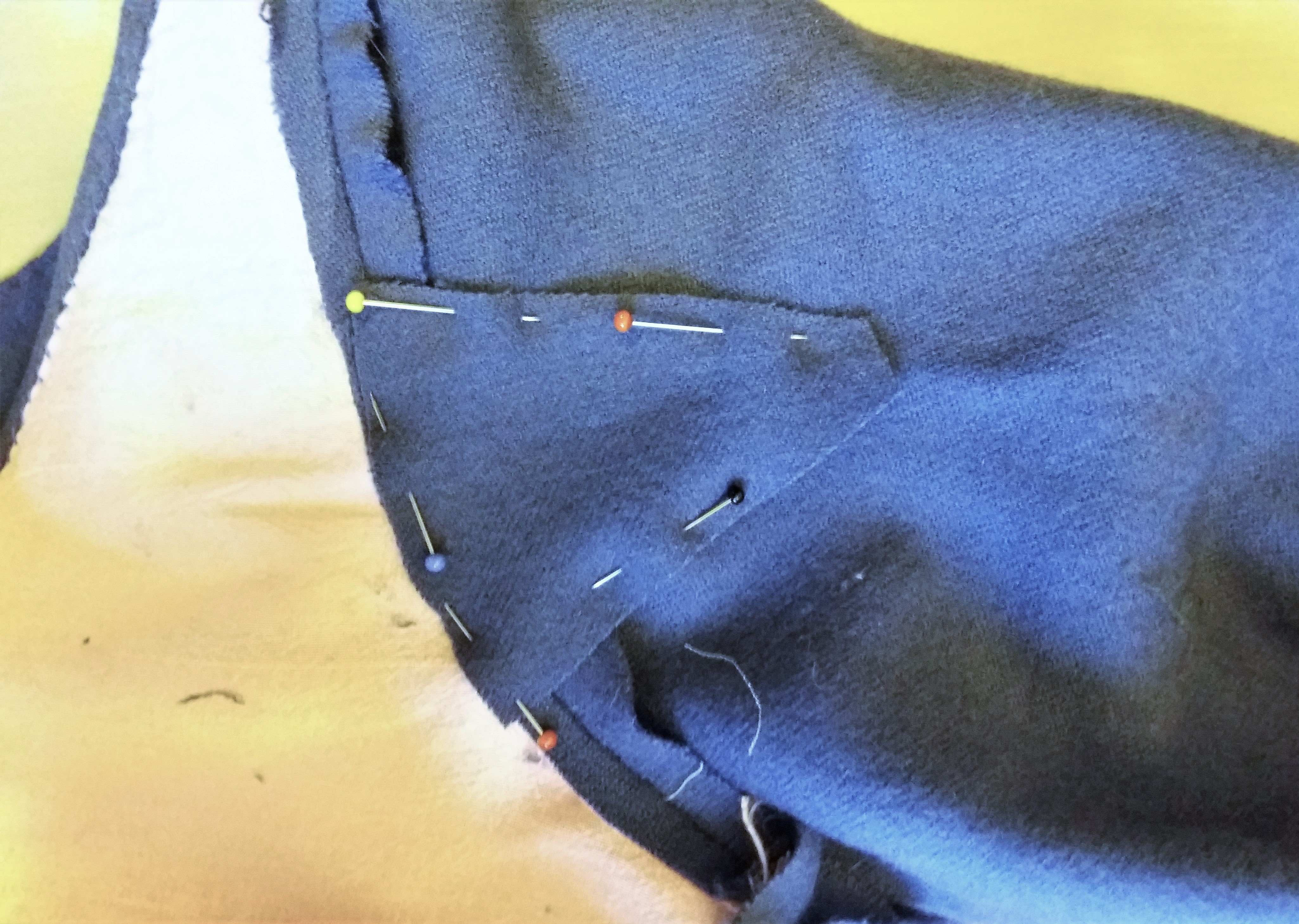
Fit the fabric gores into the sleeve slits, and pin in place (here I worked on the inside, but if you find it easier you can work from the outside of the garment).
This is what it looks like from the right side of the dress:
With pins in place, baste or sew the gore into your garment. Here I used small whip stitching, not bothering with basting. But if you are unsure or want to test the fit before sewing, basting is a great way to do that. Fastening the gore from the right side of the garment makes it easy to get a good result, since you can see the result while sewing.
When I have inserted the gore, the seam allowance is most often pressed to either side (down to the sleeve) and whip stitched down. I always press the s.a towards the bigger fabric piece. For example, sewing it down onto the sleeve and/or body piece. After that, it is all done!
The new blue gown also has a gore in the front of the sleeve, barely visible but great for movement!
At the end of each historical adventure-season I try to clean, mend and grease all our shoes. Outdoors in the autumn sun is of course the most enjoyable, but as long as you get it done it is fine. (Ideally, one would do this after each event to keep the shoes in top condition. But I am lazy…)
Shoe care: soft brush, leather grease with rag and paper.
After each adventure:
Treat your shoes with some grease after each event/market/adventure and also during longer trips. If the shoes get wet, dry them in room temperature or outdoors (never put them by the fire). You may fill them with paper to get them to dry quicker.
How to deep-clean your shoes before putting them away for the winter:
Brush away loose bits and dust, and clean the space between leather and sole by separating these and brushing away small scraps in the crack. Use a soft brush.
Wipe the shoes clean with luke warm water, and a bit of leather soap/regular soap if dirty. Scrub the soles clean with water and soap.
Dry well, filled with paper to hold the shape better.
Treat the leather parts with leather grease. I also grease the soles on turnshoes.
Dry for a day or two, and then store the shoes in a dry space. I usually keep the historical shoes in the wardrobe.
Clean between the sole and leather
Now these pair are cleaned, dried and greased!
Before the next adventure, take out your shoes and grease them again before use!
Mend your shoes as soon as you discover they are broken! A ripped seam or a loose strap needs to be sewn (you can use vaxed linen thread) and a loose rubber sole needs to be glued in place. If you are unsure how to mend the shoe, the shoemaker you bought them from should be able to help you or give you advise. A modern shoemaker/cobbler could also be of help.
Shoes might not be as visible as other garments, but they add to the historical look and experience!
Store your shoes:
Shoes should be kept in a dry space, and can be filled with paper to better hold their shape. Wardrobes, airy shelves or paper boxes are good. Shoes might get moldy if kept damp or squashed together.
How to use your shoes:
Leather turn shoes (with a leather sole) wears out quickly if you walk with them on gravel and asphalt. If you are walking a lot on those grounds, consider to bring a pair of pattens (wooden soles with straps) to protect your shoes. Or change to modern shoes if walking longer distances. I do that during Medieval week in Visby to spare both shoes and knees.
Mud is equally bad for your shoes; try to avoid it, wear pattens, or brush your shoes clean as fast as you can after a muddy experience.
When walking, remember to not drag you feet against the ground, but properly lift your feet to spare the sole. Avoiding glass and sharp stones is also good. If the shoes get a bit large, use an inner sole, a pair of extra socks or leather straps to keep the shoe firmly on your foot. A shoe that moves on your foot will get uncomfortable and wear out faster.
Buying or making historical shoes can be expensive, but with the right use and treatment they will last a long time. I use mine approximately 30 days a year, and they are several years old now!
(Want to make your own shoes? I have a weekend workshop in shoemaking planned for 13-14 November 2021 in Sundsvall, Sweden. Send me an email if you want to know more and join us!)
You really like your straw hat, but it´s starting to look a little worse for wear? Here is how I mended love’s hat!
The poor hat looks alright on the head, but take a closer look and you will find several holes and broken straw. The thread around the head was put in to be able to adjust the size of the hat to the head and make it fit snugly. It was a great idea, but have also put some strain on the straw around the head, causing it to break at several points. Time to put in some reinforcements so it will last longer! (Note that this particular material is not the one I am selling, the grass straw I use is a bit different. This hat is several years old by now)
A straw hat doesn’t need any fancy materials, it is after all mainly a working hat. I used unbleached linen, linen thread (waxed) and a little glue. When working with your hat; be gentle if the straw is thin/dry and sensitive. I will make a hatband around the outside to support and protect this area, then glue broken parts together. Lastly, I will put a ribbon inside the hat to make it more comfortable, since the broken straw tends to poke inside.
I started with measuring around the hat and cutting out a strap of fabric 4 cm longer than the circumference and 6 cm wide. This will give me a fabric piece of 60*6 cm.
Fold in the seam allowance (1 cm) and press it down on the inside of the strip, and then pin it around the hat.
Be sure to stretch the fabric carefully and evenly, to keep the size of the hat as it was before. Fold the end of the strip inside to finish it off, and then stitch it into place with linen thread. Use a thin, sharp needle and pull gently on the stitches so you don’t damage the straw while working.
You need two rows of stitches, at each edge of the fabric. Start with the one at the base of the hat.
If the straw is very broken, try to find some whole pieces to sew the fabric onto. Here you can see the seam on the inside of the hat, and me trying to find something to sew the fabric onto.
Add the second row of stitching, and sew the fold down onto the fabric for a nice finish. These steps you may use for decorating or reinforce your new hat if you like, using for example linen or black wool fabric. If the hat is a bit big, pulling the fabric around the hat will make it fit better. Remember to try it on after the initial pinning or first row of stitches so the fit is good.
Fabric strip done! Both decorative and supportive, and great if you want to pin or fasten straps or a badge to your hat!
Let’s move on to the next step! Here I use modern glue to mend rips and broken sections in the brim. Braid the straw together over the broken parts or just gently push the edges together, apply a thin coat of glue and let it sit and dry. Pick a glue that is transparent when dry, and a bit flexible (trying it out on a small piece of the hat is always a good idea). A glue that gets rock hard when drying will only put stress on the straw on the side of the mended hole, causing more damage in the future.
Here is another good method for adding support to your hat; a thin ribbon on the inside. This is loosely glued around the base, covering broken pieces and adding a softer base for the head. After the glue has dried, baste or sew the ribbon to the other fabric layer (not all the way through, use the seam allowance) and you´re done!
If the hat is a bit loose, you could use this ribbon the same way as the fabric on the outside; putting it in with a bit of strain to adjust the size of the hat.
And done! Now the hat is ready for some more adventures. Remember to always take good care of your hats so they may accompany you to many adventures in the future, clean them when necessary and store them in a flat and dry space. Good luck!
This post is a collab with Korps and contains advertisement for fabrics
Want to own a really nice cloak? Who doesn’t? (yeah, it was a leading question)
Here is my guide to the perfect cloak; we are going to look at different styles, periods, how to wear it and how to choose the best fabric.
Sources:
Let’s start with some local finds, and the oldest one first: The Gerum cloak is dated to 360-100 BCE and is an oval cloak, worn folded over the shoulders. It is a great cloak woven in a patterned twill, and wearing it folded in the middle, it will look a bit like a semicircular cloak. Wearing a big cloak folded in half, is a good way to add warmth if you don’t have a thick fabric or a lining in your cloak.
Rectangular shawl in tabby wool to a simple viking dress
Viking age cloaks can be seen on runestones, decorations, small figurines and are also mentioned in written sources. I usually call it cloak for a man’s outfit and shawl for a woman’s, but since they have the same function we will just call everything cloaks in this post.
If you fold a square piece of fabric into a triangle and wear it, it will look similar to some female figurines. Rectangular cloaks are another option, where figures are shown wearing an outer garment with corners. If you want to learn more about Viking age cloak theory; check out Viking clothing by Ewing, 2007.
Woad blue cloak or shawl, tabby woven wool fabric
The cloak from Leksand was found in a woman’s grave and is dated to the period 1100-1200. It was made from diamond twill wool, and most likely was a semicircular cloak with an opening at the front, it was also decorated with tablet woven bands at the opening (along the straight side).
The cloak worn by the Bocksten man was also semicircular with a cut hole for the neck, and a seam over one shoulder (the opening was not centered at the front) The cloak was made of several pieces of fabric, pieced together. (Kläderna och människan i medeltidens Sverige och Norge, Eva Andersson, 2006.)
How to draft a semicircular cloak on 150 cm wide fabric; it is really easy!
The cloak that supposedly belonged to St Birgitta of Sweden was also made of several pieces of fabric, but this garment is believed to have been remade from a dress.
During the 13th century, you can see lots of cloaks in contemporary sources (such as the Morgan bible), as the cloak was an important part of the outfit. During the 14th century, there are some really pretty examples of statues with buttons down the front or over one shoulder, and in 15th c paintings, they are often artfully draped in biblical scenes, but not very common in everyday portraits.
Simple semicircular travelling cloak in brown wool twill
16th century cloak patterns from Drei Schnittbucher shows examples of circular cloaks with a front opening, slits, collars and even sleeves sewn onto the cloak.
Full circular cloak pattern, look at that piecing!
Full cloak with sleeves, collar and decorative borders
Interestingthoughts:
In written sources, cloaks go under many different names depending on the time, period, appearance and who the wearer is. There is also evidence of cloaks lined with fur or fabric, cloaks with slits or trains, and of different lenght. Clearly, the garment was both used in a religious context as well as an everyday travel item.
I have not found evidence of hoods or head covering sewn onto the cloak in any finds, and when a hood is shown in contemporary art it is commonly separate from the cloak, even though it might be in the same colour as the larger garment. So if you want to make an outfit close to historical sources, make a cloak and a separate hood that correspond with the fashion of the time. (Hoods on cloaks can be seen in 18th c fashion, but let’s leave that century to another time)
Cloaks may be fastened with a seam, pin, clasp, strings, ribbons, brooch, ring brooches or buttons. Choose your method based on which period you would like it to reflect. Cloaks are fairly common in period art sources, so if you browse through a bunch of paintings you might get the idea on what to choose.
The length of the cloak seems to vary with the wearer; a travelling cloak between the knee and below the calf on men, and a bit longer on women, with ceremonial cloaks trailing behind the wearer. But paintings and prints show evidence of shorter cloaks too, with everything from decorated court cloaks to simple peasant women cloaks. Pick the length that suits your need; too much length and fabric will only weigh you down if you want a practical garment.
example of a semicircular cloak
And as always; piecing is very ok to make use of the fabric!
Different models of cloaks:
Oval cloak, square cloak, rectangular cloak, semicircular cloak (or 1/2 circle cloak), cloak with shoulder seams (or 3/4 circle cloak) and full circle cloak. The Viking age square cloak folded in half is not based on finds but more of an experiment, as is the shoulder seam cloak ( I included that in the picture though, so you may see what I am talking about). The latter I often use when I need to make a larger cloak than the semicircular one but don’t have fabric or historical evidence for a full circular cloak. The seams or piecing could as well be made on other parts of the cloak.
I have found no evidence for the cloak with vertical sections/seams to create a fit (which is popular when buying modern cloak patterns) instead, I would recommend you to choose a simple cut and then drape it on your body to your liking. Small shoulder seams or darts can be made as a more modern solution to make the cloak stay over your shoulders.
The cloak does not need to have an even hem, many examples are just draped over the body or longer back. If you want to make a full circular cloak more even by the hem, you may cut the neck hole nearer the front hem than the back hem (my full cloak is 70 cm at the front, and 80 cm long at the back). Putting the cloak on the body and adjusting the hem afterwards is another method.
Decorations:
Finds, paintings and statues indicate that embroidery, woven bands, silk or a combination of these were used to decorate the cloak, however, these examples are mainly seen on religious or high-status garments. For an everyday cloak, I would go with a sturdy, fulled fabric without decorations. If you want to decorate your cloak; try to find artwork from the period you want to recreate.
Fabric choises:
Wool, unlined or lined with wool or fur is both practical, and the most used material in cloaks during the medieval period. There are examples of velvet and silk cloaks, but only for ceremonial or high-status wearers. A sturdy, dense wool fabric that has been fulled would do well for a cloak, and beyond that, it is more a matter of when you need it (a lined winter cloak or a thinner, fashionable draped summer cloak?) There are examples of both twill and tabby woven cloaks, so again- to find the perfect cloak fabric for your period, status and adventure you would have to do some research for yourself.
Generally speaking, the right kind of fabric and the way you drape your cloak is more important than which model you choose, if you want to look dramatic. Buy enough fabric to give you the size of the cloak you need!
If you just want a good, affordable fabric right now; I include some links here to Korps.se that sells good thick woollen fabrics for cloaks. Very thick and warm fabric, or a softer and warm choice.
Colours:
The best colours for your cloak is: “yeah, it depends on..” you are starting to get this right? Period, area, status, wearer… like with all the other garments the medieval person would buy or make a garment according to what they could afford and what was available/allowed for them. Use artwork again; blues, reds and browns are seen often, and during the late medieval period dark hues and black seems to be popular. A commoner or person living in rural areas maybe had an undyed homemade cloak, while a fashionable burgher would wear something bought, dyed and cut to their taste. The cloak also differed between a garment of fashion and an everyday outer wear for bad weather; let this reflect the colour you choose.
Or, if you prefer, use this information to inspire you into making an awesome fantasy cloak for your next fantasy adventure!
This is one of my favourites; the “Fässing” (in Swedish), Martebo-sack (from Martebo church on Gotland) or a Wallet (18-19th century). It is a simple, practical linen bag made for carrying loads. I have seen medieval examples worn over your shoulder like below or larger ones strapped over a donkey.
I actually have several of these for my medieval adventures; for grocery shopping, for the picnic, for my showering things like schampoo…
Martebo bag
The bag is made with a piece of sturdy linen or hemp canvas (chose a sturdy tight-woven fabric in linen, or a piece of tent fabric for a large sack).
Cut out a rectangle with the measure 140 * 70 cm, to make a bag suitable for a picnic and your warm hood. Or design your own measures by laying a measuring tape over your shoulder and let it hang down on either side. Adjust and decide on a length you like on the bag, and then decide on the width; between 60-100 cm (makes a bag that is 30-50 cm wide) might be nice. Add 3 cm of SA (seam allowance) to each measure.
Sewing instructions:
1. Mark out the opening on the long sides on the rectangle. It should be in the middle, and between 30-40 cm wide.
2. Put the long sides on top of each other, and sew a seam on either side of the opening. Backstitches with waxed linen thread (if you are using the sewing machine, start with zigzagging the whole fabric piece, then sewing this seam).
3. Press and fold down the SA and whip stitch it down to one side for extra strenght.
4. Hem the opening with whipstitches, working from the inside. It is also good to reinforce the edges of the opening by sewing a couple of extra stitches through each fabric piece to make it less prone to rip open.
5. Now you have a tube, adjust it so the seam is in the middle of the fabric piece inside out, and pin the short edges closed.
6. Sew the edges with backstitching, and repeat the pressing and folded down SA. Done!
The sack may be carried over your shoulder, or wrap it around your wrist and hand to carry it like a grocery bag. If you have valuables in it, you can also make a knot in the middle over the opening to prevent anything from falling out. Very convenient!