There are many looks on headwear during the late 15th century. Everything from maiden hair hanging loose with soft waves, to several layers of linen veils wrapped around the head, with wimples or jewelry worn. There is both visible and hidden hairdos, fake hairpieces, caps, hairbands and circlets, as well as decorations such as pins, jewelry and braids.
In this post, I wanted to show you a few of my favourite looks and how to achieve them in simple ways.
This is a great veil, and it is simply a very long veil wrapped in layers about the head. The result gives you a turban, or if you prefer, a layered look with a loose end hanging. To keep the veil in place, add pins.
Fabric: thin linen 52*250 cm (or longer; up to 4 meters would be doable I think)
The short side should reach from forehead to neck, the long side wraps around your head in several layers. Cut out a square piece of fabric, and hem it around all sides with a small double folded or rolled hem. Use waxed linen thread, and whip stitch or tiny running stitches.
Put the long side over your head, drape the veil around your head and pin it at the neck (do not make a knot, that will be too bulky and doesn’t look right in the end). Wrap the veil several times around your head, and secure it with more dress pins. Alternatives; wear it on top of a cap, headband or hairband. Let the end hang loosely, over one shoulder.
You can also wrap the veil folded, to achieve a more smooth look. The “secret” with making the look hold and look nice? Practice, mostly. I like to wear a base, like a version of the Birgitta cap, and then pin the veil to this one. When I wrap the veil around my head, the layers will go a little different each time, to cover the whole head in a good way.
In this look, the layers are wrapped from behind and then from the ear, over the forehead and a little back, to achieve the V shape at the forehead. This looks need some more pins at the top of the head to stay in place.
Veil with sewn layers. This veil is an experiment to achieve the look seen on many paintings from the period, in very easy means. A more historically accurate way would probably be to use a very long great veil, or the “strip with sewn folds” with a veil on top. But if you want to look the 15th century part easy and fast; this is it!
Fabric: thin or medium-thin linen 64*250 cm
Cut out a square piece of fabric, and hem it around all sides with a small double folded or rolled hem. Use waxed linen thread, and whip stitching or tiny running stitches. Then measure and mark folds on one short side, as many as you would like (between 6-20 folds). Make the folds by hand, press them down, and sew them with running stitches. At the ends (the long sides of the veil) you can make the folds go together to add some shape to your piece.
Put the veil over your head with the folds at the forehead, and pin it at your neck. The veil should hang over the pin and hide it. Then twist the veil fabric around your head until you have used the whole length. Tuck the end in under some layers, and pin everything in place.
Strip with sewn folds
Fabric: thin linen 64*20 cm (64*30 cm for more folds)
This is made either to pin on a cap or fasten on your head with pins or ribbons at the neck. On top of it your wear one or more veils. A practical way to style your existing headwear into the 15th century style.
Cut out a square piece of fabric, and hem it around all sides with a small double folded or rolled hem. Use waxed linen thread, and whip stitching or tiny running stitches. Then measure and mark folds along the long side, as many as you would like and can fit (between 6-20 folds). Make the folds by hand, press them down, and sew them with running stitches. At the ends (the long sides of the veil) you can make the folds go together to add some shape to your piece. At the ends, you can make the folds go together to add some shape to your piece. Use two thin strips of linen or silk ribbon to fasten the piece at your neck, if you don’t want to pin it.
Here is the strip, pinned down on a cap, and covered with layers of veils.
I have been experimenting with some other veils too, but I’ll have to come back to them another time when I have put together my experience and drafted some patterns for you.
For the Golden Egg challenge, I made a warm, woollen coat. The purpose of the coat was to make an over-garment from sources that would be warm, practical and fitting for the period. After using it for half a year I am very satisfied; it is such an easy garment and yet it looks great, is comfortable and versatile. I use it as part of the outfit, when the weather is cold or wet, as a robe when visiting the bathroom early in the mornings, as a picnic blanket…
I drew you a basic pattern outlay if you want to try it out for yourself.
The small gores F1 and B1 are just to save fabric, so the main pieces are 2 fronts, 2 backs and 2 sleeves. If you have a toile or mock-up that works for you, you can use that as a base and then just draw out the lines from the sleeve/neck as I did on the pattern.
The fabric I used was 310 * 150 cm, if you are taller or need a size large or above, consider adding some extra fabrics for lengths and sleeves. You don’t really need as much width as I have, but it will give you a very nice drape and look.
The cut and pattern are based on paintings and what pattern instructions I have found from the period. I think it is a possible take, though I have seen outer garments with S-sleeves, sleeve gores and more intricate patterns and constructions. The side seams can be found in some pictures, as well as in patterns of outer garments from later periods.
When you have cut out the pieces needed, pin/baste and sew the coat together in the following order:
back seam
shoulder seams
side seams
sleeves
insert the sleeves in the coat
hem the coat
put in a closure at the front neck.
I used unbleached, waxed linen thread and a running stitch, folded the seam allowance to one side and fastened it down with whip stitches. The hems were finished with whip stitching too.
I also trimmed the neck and sleeves with fur, since that seems to be common in contemporary art. To avoid dipping the sleeve hems in food, I made the sleeves wide enough to be able to fold the fur inside the sleeves when working- this turned out very practical!
Materials:
The coat is made in warm, thick wool twill, with a rich, deep brown colour that would have been quite expensive to dye. Other good colours could have been walnut brown, red or black.
Linen thread for sewing, since this seems to be common in most finds from the period.
Rabbit fur for trims, because that was the only fur I found that was up to my ethical standards about how you should treat animals (eco, small family garden breeding, killed and tanned in the area without chemicals). White fur to match the paintings. If you don’t want to use fur a folded down hem would do just fine!
The clasp is based on a find from the period and is made in bronze
You can wear the coat loose, or close it with a belt. I often wear it with a belt, as it is more practical. If you want tips on sewing a fur trim on a garment, check out my tutorial on the subject!
Historical sources and why I did a coat
The outer garment could be a dress as well, as there are lots of warm dresses lined with furs or fabric in sources. I chose the coat as I wanted a practical garment, and know from experience that the second layer of wool dress would not be versatile enough for what I needed. The sources I have used are from the second half of the 15th century, in today’s Germany. The Golden Egg outfit is based mainly on the period 1470-1490, but the coat belongs to the end of this period rather than being the “choice of all women”. So now you can decide if you should go for the practical coat or the more common dress when making your outfit!
OLYMPUS DIGITAL CAMERA
Sources: if you want to check out some sources on 15th century clothing, I recommend some of these links:
This is my walk-through on how I made my green 15th c kirtle/dress in wool. It is not a complete tutorial with all details, so if you have never sewn before I recommend starting with a shift or other straight garment. If you want more good sewing tip, you will find many problems addressed in my other tutorials.
This is a common late 15th c middle dress for women, it is quite easy to make, practical and is shown in many different pictures from the period. Your choice of colour, neckline, clasps and other details will make it different, and if you choose a thicker wool fabric it will work as an overdress too. The artwork I have used is from 1470-1485.
You will need about 3-4 meters of thin wool fabric, I bought mine from Handelsgillet, they have a thin twill fabric that is easy to work with and quite historically accurate for the period. I fell in love with the perfect green colour… And you can see some examples of green kirtles at the bottom of this blog post and in other artworks from the period. The shade can be achieved with plant dying but is more expensive than a madder red or yellow, and I think it makes a good option for my outfit; a well of burgher from a city.
I lined my dress with prewashed, unbleached linen, but you only need to line the upper body for some stability, and that will need a maximum of 1 meter. I sew my dress by hand, with waxed linen thread. Running stitches for the main seams, back stitches in armholes and sides, and whip stitches for the seam allowances and hems, are all you need. The dress closes with hooks and eyes, be sure to have lots of them!
This is what the model looks like, it is really simple, and if you have a personal toile/mock-up for your upper body you can use that with some small modifications. The front opening should have a slightly curved seam to follow your body, and the closure makes the front pieces lay edge to edge.
Comparing to a supportive kirtle, you need a bit more room now for your bust area, it should be quite loose and lay over your breast, to get the shape of the period. Make a new mock-up in fabric and make the front pieces a bit wider, and try it out.
The sleeves are regular S-sleeves or a sleeve with a curved upper edge and seam under your arm. You can see both from the period, though the S-sleeve seems to be more common. The skirt is made up of 4 pieces in my dress. Here are the pieces I used together with my measures (around 36-38/small European size)
The dotted line on one of the skirt panel indicates a gore to save some fabric, but I wrote out the wrong number of pieces; the left panel is the front and you only need one of them. But this is just one way to create the skirt; you can use more pieces, gores, or just 2 wider parts.
The upper body back piece is whole, you can shape the back in the sides and with the help of the waist seam.
I lost my sketch of the outlay but made another one just to show you. Since I am a rather petite person, I can use the width of the fabric for most outlays, but if you are longer than I am (around 160 cm) you may want to lay the skirt panels out the other way. In this picture the panels are a bit wider in the back than that above, so you only need two. The front is straight or almost straight. Note also that I apparently drafted regular sleeves instead of S-sleeves, but you will get the idea…
After I cut out all the pieces, I basted the dress together to try it out. When happy with the fit and measures, I started to sew all the seams by hand. If you keep the correct basting stitches while sewing, you don’t need to pin and can easily work on the sofa, super cosy!
Make the dress in the following order:
Sew the upper body together, front and back pieces, and then sew the sleeves before you insert them in the body.
Sew the skirt panels together, but leave around 20 cm at the top centre front, to be able to put the dress on (the slit shown on the first sketch). I hemmed the body and the skirts upper circle separately, and then attached them to one another with whip stitches. This seam will get a lot of wear, so it is nice to make it twice or use a sturdy thread, like the buttonhole silks or a thicker linen thread, like 35/2.
When the whole dress was assembled together, I put it on my doll to hang out for some days, before I cut and hemmed the skirt and sleeves. If you have a doll, it is really good to leave the dress hanging for a couple of days before hemming, this will make the fabric in the skirt stretch out, and you can cut away excess fabric to make the hem even.
The front with its lining is sewn from the right side, first with basting and then with a seam. To make the front opening and the neckline more durable I added a second row of stitches around.
The hooks and eyes are fastened last. This is what it looks like on the inside, note that I have sewn the hooks and eyes not only in the loops but also at the stems/higher up. This will make your opening lay flat and give that characteristic look at the closure you can see on 15th c paintings.
And finally, some of my favourite artworks that I used during my research. As you can see, they are all green kirtles, of the same models, but with some different cuts, necklines, closures and headwear.
Historically accurate? My main aim with making this outfit was practicality, durability and a dress I would feel comfortable in, based on period clothing. With this said, I aimed to make the dress (and outfit) as historically believable as possible from my means.
The fabric is machine woven and dyed to cut on costs, but the pattern construction, sewing techniques, material and look aims to be close to the dresses from the period. Another modern take is the hooks and eyes, which are machine-made instead of handmade.
I rarely work with metal due to some problem with my joints, but I tried to make a couple of hooks and eyes by hand. It is not hard work, they got quite pretty, but I didn’t make enough of them for a dress.
One thing I did give a lot of thought was the lining. My experience is that lining a skirt with a different material that is sewn down in a slim hemline rarely gives a good result. But I was curious and gave it a try with the method of letting the skirt and skirt lining hang down before cutting and hemming. It worked quite well but gave me a lot more work than leaving the skirt unlined. In artwork, you can often see a lining inside the dresses, and this was a try to make one without adding warmth with another wool layer.
This post is about my work with 15th c dresses for the Golden Egg challenge I do in the SCA, and it will be something like an overview on dresses. If you want pattern outlays and sewing tutorials, check out my tutorial page!
What is really the difference between a kirtle, middle dress, dress, underdress and so on? Not much, except the words. All these can be used for the same garment, depending on the country of origin and the period. A kirtle refers to the main (upper body) garment for both men and women, which should be long (and loose at the hem). A tight-fitting, short garment with the same function is called a jacket or doublet. A kirtle can be both a tunic and a dress. So it is more of a language term than a specific garment.
Dresses are basically what you think it is; long garments (for women in this post) worn in different fashions, styles and materials. The medieval women generally wore several layers of garments, so to better talk about these, they are given different names.
The shift, chemise or underdress is your underwear, usually in bleached or unbleached linen, washed frequently as you would do with modern underwear.
The supportive shift is a sleeveless, tight underwear to support and shape your bust. You can see it in both pictures and as a find (Lengberg). You can wear it on its own under the middle dress, or together with a shift with sleeves.
The kirtle or middle dress is the next layer, often in wool, but also in silk, cotton, velvet or mixes of materials. You can wear this in public, and during the 15th c, it is often tight fitted. The cotehardie? That is french, meaning basically a kirtle but is referred to as a tight fitted 14th c garment for both men and women, often with buttons or lacing.
The dress or overdress is a warm layer worn on top of the first two, during the 15th century it is often loose, with lots of draping fabric. And as expensive as you can afford it. The houppelande? A certain style of overdress, with an opening at the centre front, often elaborate sleeves and lots of fabric in the skirts.
The coat or cloak is a layer of its own, to protect the wearer from the weather (or for symbolic/religious use) or as a fashionable garment. Women and men both wear them and own them in sources, but they don’t seem to be high fashion during the 15th c, more like a practical choice.
OLYMPUS DIGITAL CAMERA
During the 15th century, fashion seems to change quite fast, and you can also see many different styles of dresses in the same picture or geographical area during the same time. If you want to research different kinds of styles yourself, I recommend diving into some artwork for the period. I have two pinterestboards to check out, one about my Golden Egg project here, and another on interesting 15th c clothing here.
I also wrote a post about research and artwork here. I could really go on and on about different models of dresses forever, but to keep it simple I am just going to show you some different examples I have tried to recreate from the 15th c:
For my wardrobe, I opted for the green kirtle, a simple dress with long sleeves, a waist seam and front closure with hooks and eyes. The sleeves can be loose enough to roll up to the elbow, or a tighter version like mine. The front opening continues after the waist for a bit, to make the dress easy to take on and of. Decorative clasps by the front or lacing seem to be options for this style. It also seems like the kind of dress you can wear as both middle or overlayer on your outfit, depending on how you fit it and the choice of material.
But I also got curious and tried out the loose dress model with my dove blue dress, based mainly on a picture from Bohemia. These model can often be seen with a decorative closure at the neck and is held together by a thin belt by the natural waist. The breast can be seen as two individual shapes; you need a supportive shift with separated cups or a modern balconette bra to achieve this look! (or go natural)
Before, I tried to recreate this kirtle with short sleeves and a waist seam with a plaited back, based on some artwork of Weyden. The sleeves have a seam under the arm instead of the more common S-sleeve, the middle back has a seam, and there is a strip of fabric around the neckline, as a way of giving support to the shape. The front of the skirts lay smooth to the upper body, but at the back, there are plaits to add volume and a nice drape to the dress.
The houppelande is such an interesting garment, and I have tutorials about the different pattern and outlay. These are some of the different versions I have made. I really am a fan of this green colour as you may have noticed, and my friends use to joke with me if I don’t wear green at events…
This is a tutorial with very detailed step-to-step instructions, and I will base other tutorials on this one and simply state “do as in the simple dress tutorial but…” so this is a go-to for many different garments. I call it the simple dress since it is so versatile, the base for so many other garments!
It is also suitable to make men’s kirtle, tunics and coats, just adjust measures and fitting to a male body. Most garments are more difficult to make for women’s bodies since the measures differ more, and therefore you will find more tutorials on my page for women’s clothing.
This is the dress we are going to make. Note that a regular S-sleeve does not have two seams, only one at the back. The reason my dress have two seams in the sleeves are 1. you will learn how to make that for doublets, jackets and 2. I saved fabric that I was short on.
Good tips:
If sewing on a sewing machine, pin from right to left, across the seam, to make it easy to remove the pins while sewing. If sewing by hand, pin along the seamline so as not to get the pins in your hand, or baste the seams before sewing.
When pinning; always lay your pieces on a flat surface (a table or the floor) and work on that while pinning. This will make the work easier, and the seams better.
Basting seams are an easy way to try the fit, size, movement and drape of skirts while sewing. Basting the armhole before sewing makes that seam easier to finish nicely. When you pin/baste together long seams, such as a diagonal cut gore with a straight panel, put the gore (the diagonally cut stretchy part) under the other one, when sewing on a machine the gore will not stretch.
Don’t be afraid to cut out your armhole according to your body. The sleeve should cover your arm, the arm joint, but fit snugly under your arm (in the armpit). A too shallow armhole will make your sleeve hang, but too wide will make movement hard. Experiment on scrap fabric first.
How many gores? Two are enough for undergarments and knee-long kirtles, four or more will give you more width, a smoother and more even fall of fabric and more movement when walking. Regular seam allowance is 1,5 cm. For hems 2 cm. You can pick whatever measure you want between 1 cm-3 cm, just remember what you chose. Seam allowance is mentioned as SA in this post.
Wash and iron your fabric before sewing. The fabric is prepped with chemicals to avoid mould or bugs during the shipping and selling process and could be stretched uneven after the weaving. It will also most likely shrink a little, so this makes you able to wash your clothes after using them.
Start with your measures:
Around your widest part on your upper body(often over the bust).
Length of the garment; from shoulder to hem.
Length of arm; from shoulder-elbow, while bent 90 degrees, to the wrist.
Around your wrist (for tight buttoned sleeves) or around your hand to be able to take on and off the garment.
Create your armhole (if you find this hard; try to measure around a loose shirt or blouse. The armhole should be a bit loose without hanging).
Length from shoulder to natural waist (for women) to hip (for men). This is where I attach the gores.
Draft the pieces you need on a bit of paper. Calculate the measures you need:
Around your widest part of torso: Divide in 2. Add seam allowance: 3 cm/piece. Add some extra for movement: around 6%. Example: around bust: 100 cm. Divide in 2= 50 cm. Add s.a = 53 cm/piece. Add movement = 53 + 6% = around 56 cm. Each piece is now 56 cm wide.
Length of garment; from shoulder to hem. Add seam allowance: 2 cm = hem + 1,5 cm for shoulders. Example: dress should be 140 cm when finished. Length of piece: 143,5 cm.
Length of arm; from shoulder (around elbow while bent 90 degrees) to wrist: Example: 64 cm. Add SA., so sleeve pieces should be 64 +1,5 +2 cm= 67,5 cm. Try on before hemming to adjust the length to your taste.
Around your wrist (for tight buttoned sleeves) or around your hand to be able to take on and off the garment): The narrow part of the sleeve. Check so you can put it on/off. Shape the sleeve to your taste so it fits comfortable around your arm while sewing the sleeve. This is just the starting measure.
Around your armhole (if you find this hard; try to measure around a loose shirt or blouse. The armhole should be a bit loose without hanging). The measure you got is divided into 2, for a measure of the sleeve hole on the front and back piece. Example: around my armhole, I have 56 cm. 56/2=28 cm. Each armhole on the pieces should be no more than 28 cm (measure the curve).
The sleeve base should be 2 cm wider than the complete armhole. 56 cm + 2 cm= 58 cm (measure around the S curve of the arm) add SA: 58 + 3 cm= 61cm is the sleeve base measure.
Length from shoulder to natural waist (for women) to hip (for men). This is where I attach the gores. For example: my measure is 38 cm. From the shoulder, I measure 38 cm and make a line, here is where the gores should be attached on front and back pieces. For gores in the middle back and front, cut a straight line to 1 cm below this measure (39 cm from shoulder) to insert them. Check out my tutorial on how to make these
Length of gores: length of the dress – length from shoulder to waist/hip + 3,5 cm SA. Example: 143,5 cm -38 cm = 105,5 cm + 3,5 cm = 109 cm.
The width of gores depends on what kind of dress you would like to do, your overall size and how much fabric you have. I recommend a measure between 50-80 cm for each gore. A lower-class garment might have narrower gores, a fancy dress wider. If you calculate on a larger size than this example, let the width of the gores follow the other measures. For example: if your circumference around your torso is 20% more, also add 20% width to the gores. This will make sure the dress keep good proportions and all the drape.
When calculating all these measures, draft them out on your pattern pieces to remember them.
Then, draft all the pieces on your fabric with a fabric marker and ruler. Check that you have made all the pieces with the right measurements and that all are drawn onto your fabric before cutting. Mark them with front/back/sleeve/gore.
Cut them out. If I work with linen, silk or brocade that will fray, I sometimes zigzag around all pieces on my sewing machine.
Sew the pieces together in this order:
Shoulder seams
Make the sleeves
Attach the gores to dress front, back, sides
Side seams; front to back and gores so the sides will be completely closed
Sew the sleeves into the armholes
Hemming and adjusting length
Note: This work order goes for both the sewing machine and hand-sewing. When I make a seam I finish it off before starting the next one. That means;
pinning/basting
sewing the pieces together front to front
pressing down the seam allowance on the wrong side (the inside)
cut down the seam allowance on one side
press again, the wider over the cut one
whip stitch the seam allowance down (can also be done when the dress is ready if you want to try the fit during sewing)
The reason to press the seams before sewing another one is that you will have flat and nice looking seams, and it will be easier to make the next one crossing the first. I really recommend you to at least press the seam allowance once, it makes such a difference!
Step-to-step for sewing the dress.
Sleeves:
Pin the seam on the S-sleeve (the back seams if you have a sleeve in two pieces.
Sew the seam with running stitches or a sewing machine. Remember to fasten/lock all seams at the start and finish. Here 1 cm SA is shown. I prefer 1,5 cm to easy fell the seam and whip stitch it down.
Press the seams with an iron. If you use fine wool or silk, a damp pressing cloth (cotton cloth) can be used between iron and garment pieces to avoid pressing marks. In the photos below you can see the difference between a pressed and a new seam. Totally worth the effort!
When pressing: press the SA to both sides. Let it cool. Cut down one of the sides to half the width. Press the other SA over the cut one, pin down if necessary. This will create a sturdy seam when sewn down, saves you time and looks neat on the right side.
Pin and sew the other sleeve seam (if any). Press it the same way as the first seam. This is easiest with a sleeve ironing board, but if you don’t have any; press the seam with the sleeve laying flat on the board. Try to avoid creating folds in the sleeve with the iron.
seam on the inside of the sleeve
These photos show the technique with and without a sleeve ironing board
Gores:
This dress use 4 gores, one at the middle front, one back, and one in each side seam. The gores give you movement and a good drape to the skirt. On female garments I want the gores to start by the natural waist (where you are slimmest) to accentuate the curve of the hip and belly. On men’s garments, I start at the hip bone to give movement but no feminine curves.
Tip: When drafting your gores, do not make them into straight triangles, but make them slightly curved at the base. Like in this example: the gore should be 100 cm long, and as you can see the rectangle is just that, so the gore will be exactly 100 cm at the middle, but at the sides, you need to measure from the top and down, 100 cm, and that will be a bit shorter than to the line.
Why? To get the right measures, and a good shape at the bottom hem, as described in this picture:
The gores are cut at a diagonal/bias on the fabric. This means they tend to stretch more than the front and back pieces when pinning and sewing. To avoid this, work on a smooth surface and pin + sew the seams with the gore under the front/back piece. This is mainly a problem on a sewing machine with too much pressure on the presser, but also a good tip for hand sewing.
One gore has a seam in the middle to save fabric. Pin, sew and press this seam first. I like to place this gore in the back so it wont show, and to create symmetry in the dress. Then, cut the front and back center to be able to attach gores there. Make the cut line about two cm shorter than the gores; like this:
Start with the side gores, pinning them to the front. Sew them in place, and press both seams the same way you did with the sleeves.
Pin the front and back gores to the front/back pieces, right side to right side, one seam at a time. Sew it but leave the last 6-8 cm at the top. Repeat with the other seam, so you will have two gores with the tip lose. I prefer to make the tip by hand, from the right side of the garment
3 different ways to insert gores:
Press the seams you made, and press the SA on the front and back to either side of the slit, as if it was already done, from the wrong side. When reaching the end of the slit, the s.a will become narrower, and then disappear. Turn the piece and work from the right side. Pin the gore in the slit, so it lays flatly under the already pressed s.a of the front/back. Then sew it in place with a small whip stitch. With this method, you can check the gore to be sure it fits nicely, and it does not matter if it turns out a little bit too big; it will look perfect!
Another method is to sew the whole gore with this technic, if you sew your garment by hand. This is also historically accurate. Start with pressing down the s.a on the front and back slits, and then pin the gore along each side, and sew it from the right side using whip stitches. Press the s.a on the wrong side, and sew this down with whip stitches on the wrong side to, like when felling the seams in the sleeves.
If you only want to use the sewing machine, work on the inside of the garment, and continue with your sewing machine seam to the top of the gore, making the SA narrower as you go along the last 4-6 cm. If it is hard to see, fasten the seam, turn the gore up and sew it from the other side (still on the inside, just flip the garment from front/back to gore side). This might take a few tries before you get it right, just go slow and be prepared to rip the seam and try again if not satisfied.
When the gores in front and back are finished, sew the side seams; the side gores to the back piece and then the side seams (leave a hole for your arms for now. When all the gores are finished, remember to press all the seams!
Neckline:
I like to draft the neckline by hand for each garment, to be able to adjust it to each look I want. The secret is to try it on often, and just cut away a little at a time. You can choose between pinning, basting or sewing the shoulder seams before this. Make them the same way you did the other seams, but don’t press them yet.
Start with drafting a neckline, and armholes. Put the front and back on top of each other, mark the middle and draft a small neck-hole. Mine is 18 cm across, 9 on each side of the middle. Make it shallow, about 4 cm, just in order to try it on. You can then draft the shape and size of your neckline directly on your body in the shape you want (just put the dress on, inside out and draft in front of a mirror. Copy the side you liked best to the other side, left or right. The neck will probably just be cut down with some cm, depending on your size, while the front will be deeper. Remember to leave 1-1,5 cm SA; when you hem the neckline it will be a bit bigger than before.
Arm holes:
Making armholes is much easier if you already got a toile/mock-up to copy, but you can try this too: Put the dress on, inside out, and draft the armholes where your shoulder joint start, follow the curve at the front. Mark where the holes should meet at the side, as tight under the arm as possible. Do this at the back (ask a friend) or take the dress off and draft on a flat surface.
Now you should have a drafted line at front and back. Measure these ones, and compare them with the measure you took for your armhole in the beginning. Redo if necessary, the armhole should be a bit narrower than the sleeves (about 2-4 cm) in order to make a well-fitted sleeve. The front curve is deeper, and the back more shallow, but they should start and finish at roughly the same place on the shoulder seam and side seam. It does not matter if one line is a bit longer (front/back) than the other, as long as the circumference is correct.
This is the difference between the front and back of my dress. Note that I also cut down the shoulder seams to become a bit sloping. This is optional for you, if you have very sloping shoulders it will help you with the fit. If needed, do this before the shoulder seams are finished. Then sew the shoulder seams and press them.
Attaching the sleeves
The next step is to attach the sleeves, and I will be honest with you; it can be a bit tricky at first, so don’t give up if you have to rip the seam a couple of times before you get satisfied. The most important thing is to take the time to pin/baste the sleeve to the body and check it out. Don’t hurry!
You will have two sleeves, sewn together to tubes. Baste the sleeve cap (top curve of the sleeve) with loose running stitches.
If you want to check out how the fit is; baste the sleeves around the armholes, and try the dress on. Move around, stretch. Bulkiness at the front might be trimmed down a little. If the sleeve seems tight on top of the shoulder a bit more sleeve fabric might be moved upwards. Do not bother if the sleeve gets a little creased or has small folds, that will be possible to fit inside the armhole, that is what the basting is mainly for. When you think you have something:
Mark out the top of the sleeve (towards the shoulder seam) and the bottom (armpit on sleeve towards the side seam) with a marker or pin. Maybe there will be more sleeve on the back of your body, but that is just fine, you use it when reaching in front of you. Now you are ready to sew the sleeve into the dress!
This is a step-to-step on how to insert a sleeve in the armhole and make it fit. Use it as a guide if you felt unsure about the above: Turn the sleeves to the right side. Put the sleeves inside the inside out dress, and fit them into the armhole. They should lay right side to right side now.
Pin the sleeve marked shoulder – shoulder seam and marked armpit – side seam. Continue to pin the armpit, the part under the arm. Lay the fabrics smooth against each other, no folds.
The sleeve is a bit wider than the armhole, so it should make small waves, like in these pictures. This will be solved with the basting thread you sew on the sleeve. Gently pull them to gather the fabric of the sleeve a bit, in order to fit it inside the armhole. As the sleeve follow the arm hole curve better, pin it in place. The fabric should not make folds, but only gentle crinkles or waves. Adjust if you need. The basted and pulled together fabric should only be pinned to the upper half of the sleeve, never in the armpit.
When you have worked your way around the hole with pins and like the result, baste it in place with big running stitches. Make the other sleeve up in the same way, or try to make it the same… When satisfied; flip the dress to the right side, and try it on. Check the fit of the sleeves and your movement. A bit bulkiness around the armhole is ok, but there should not be folds or stretched fabric sections.
If it looks good, turn the dress back inside out, and sew the sleeves following the basting (with machine or backstitches). Then remove all the basting stitches.
To finish the seams, press them on a sleeve ironing board, or roll a bath towel firmly and put it inside the sleeve if you don’t have one. Press the SA down in each direction, then finish the seams like the ones before. I press them towards the body and whip stitch them down.
Wow, good job! Almost finished. Try the dress on again to adjust the length, hemline, sleeve hems and neckline if needed.
The sleeves should be a little too long when the arm is hanging, to fit nicely when you use your arms and bend the elbow. Check, mark any change you want to make, and do the same to the neckline.
Ask a friend to check the hemline of the dress so it looks even, mark a new hemline if needed. Remember to check the length with the correct shoes/belt since these can make a difference to how long the dress look. When satisfied, cut away any excess fabric and hem the dress. I prefer to fold the edge twice and whipstitch it down by hand. Remember that our SA for hemming was 2 cm. Thick wools only need a single fold before sewing.
Thats it! Now we have a nice dress, and you can use this tutorial for other garments as well.
Did you like this post? You can find a step-by-step video on a similar dress along with more guides and pattern on my Patreon. Join me there to help me make more tutorials!
This is my method for attaching pewter buttons to a garment. It is easy, simple and makes it doable to remove the pewter buttons before washing or to use on another garment, and then re-attaching them quick afterwards. Another great thing with this method is that you will not lose your buttons as easily as if you sew them onto the garment one by one, since you will have a secure ribbon to hold them in place.
Here is where I start; the sleeve at the top is finished, and the sleeve at the bottom already has its buttonholes and hems. You will need to make S-sleeves (with the seam at the back of the arm, going just over your elbow) and then fit them snugly over your underarm. I recommend doing a mock-up sleeve first in a cheap fabric to try it out. Do you notice the curved edge of the bottom sleeve? That will create room for the wrist and the start of the hand which are also inside the sleeve.
Start by marking out where to place the buttons, use a pen and compare with the already made buttonholes. Work on the inside of the sleeve. Depending on the size of your buttons you will need different seam allowances, I had small buttons and used 1 cm, but recommend that you use at least 1,5-2 cm.
Use an awl and make small holes in the fabric, for the buttons to go through. If you have a thin or sensitive fabric, you need to reinforce the sleeve before you begin, otherwise, the buttons may rip through the fabric when put under stress, such as moving or lifting when wearing the dress. A simple piece of fabric would do the trick, like on the sleeve above where the buttonholes have a strip of silk (sturdy linen is better to work with). Sew it into place before making the holes.
Do you see my trick now? I do not sew each button in place separately, but pull them through the holes I made with the awl. When I have them in the right place, I thread a sturdy ribbon (this one is in linen, but a braid, twisted linen threads or anything similar will go) through each buttons loop, to keep them in place.
The ribbon makes the buttons stay in place, and makes it impossible to lose them. Note that the ribbon is twisted from left to right to pass through each button from the same direction, this will give you a smoother seam later. The buttons are placed with the flatter side towards the sleeve.
When the whole set of buttons are attached and the ribbon threaded through them, fold the ribbon back, and leave a piece of it lying under the loops to keep it in place.
Final step! Fold the seam allowance over the buttons stem, loop and the ribbon, and whipstitch it in place. To remove the buttons, you will just have to rip the whip stitch open, remove the ribbon and take out the buttons to wash the dress in the machine, or use them elsewhere on another garment. To replace the buttons, repeat the steps above (the marking and holes should be left so you don’t have to redo them).
It takes me about 30 minutes to reset a sleeve, so quite doable instead of having to buy new buttons for each garment you make. This also works on bronze buttons of course, but fabric buttons I usually sew onto the garment one by one as is visible in finds from London (Dress Accessories 1150-1450). Also, note that you need the typical medieval button with its long stem, most modern buttons are flat and don’t work with this technique.
Some time ago I made a medieval bathing dress in unbleached linen, and I wanted to share it with you. It is a simple project, perfect for an evening or if you want to practice hand sewing. There are plenty of bathing dresses in paintings from the late 14th to 16th century in Europe, they can also be seen in different cuts and models, and some are clearly supportive shifts that you could wear under your medieval clothing. Mine is very simple but with an intake under the bust to allow some support, but still being easy to get in and out from. No lacing is acquired.
Left; Bohemian, Codices vindobonenses 2759-2764 in the Osterreichischen Nationalbibliothek, in Vienna, Austria. Right: The Bathhouse Attendant, Bible of Wenceslaus IV. 1389.
This find is from A History of Costume, Kohler and is dated 14th century and described as a lady’s chemise or undergarment, the photo is old but you get the general idea.
Most of the pictures I have found seems to be dated to the late 14th to early 15th century, there are lots on the internet and I have a Pinterest folder on Medieval underwear so I won’t go into more historical sources today.
The cutting out; prewash your linen, fold in double in the length you would like, and then cut the A shape. I used the leftover fabric for gores in the sides (and at centre front + back if you like, it is optional) but this of course depends on your measures.
The first pictures show the general cut, the second the additional front and pack gores, the third the intake under the bust that give me the support. Do not take in too much, because then you won’t be able to get in and out of the dress.
About measures: The length of the dress measures from armpit to hem. The width is your measure around your bust divided in two (for front and back) add seam allowance but nothing more. Start the gores at your natural waist (if you are unsure, rather place them higher than lower) and pin the intake under your bust while wearing the dress with gores and side seams sewn/basted. Add shoulder straps last, mine is just double-folded linen cloth, whip stitched together and then fastened at the same position as I would have worn bra straps.
If you sew your dress by hand, use waxed linen thread and running stitches, and then fold the seam allowance to one side and whipstitch in place. This gives you a sturdy seam that is also quick to make. Hem the dress with running stitches or whip stitches, after your choice.
Making the dress in unbleached linen made it opaque even when it was wet, good for modesty. In artwork the dress seems to be white, may be visible nipples was a thing, or you would have to pick a very dense fabric. In some pictures, it is very clear that the fabric is transparent, but I chose the more sturdy and practical look. (update spring 2021: I have found that if you start with unbleached linen fabric, and sun bleach it yourself you will get an almost white fabric that is not as transparent as the modern bleached options in stores.)
The result? All considered, I am satisfied with the cut, sewing and look of the dress. It is also easy to swim in. Historically, being out in public in a bathing dress was not a thing, they can be seen on bathhouse attendants or in rare cases during the dressing/undressing at home or during dirty labour. Wearing it to the beach was certainly not a thing, but I liked to have a more historical dress instead of wearing a modern bikini when going for a swim at events.
I have been reading up on 15-16th century medieval Europe, including art and clothing, for some years now and haven’t really been into the 14th century for a while; I even sold of my Moy Bog gown and some other dresses. But then my friend J told me she wanted to brick stitch embroider a couple of purses, and I could have one in exchange for a minor handcraft effort (at least I thought so- I’m not really into embroidery…) and then I would need a fitting dress to that… And in almost no time I had this one finished, a hand-stitched cotehardie made of thin wool twill, with silk lining, silk lacing at the front and short sleeves.
The dress is for the higher classes, and in pictures from the late 14th century, it is worn with a kirtle underneath (a tight-fitting dress often with buttoned sleeves). Then it seems like the dress remains in the beginning of the 15th century, and is worn as a kirtle/middle dress with loose sleeves for a more fashionable look. After that, the dress seems to change a bit into the waist seam dresses (like my blue Weyden dress). This kind of dresses is very common in contemporary art and you can see them in different countries, with long or short sleeves, a laced front or a hidden side lacing, and with buttons or lacing at the sleeves.
If you would like to make a dress like this for yourself, search late 14th and early 15th art sources (I have some at my reading tips) or look at my Pinterest board about cotehardies.
Here are my best tips for making the dress fit nicely:
Fit the sleeves in carefully, they should be snug around the arm for both good movement and the right look.
Make the lacing holes 1,5-2 cm from each other, no more, to make sure the lacing will not show the shift underneath.
Use a lining inside the dress to make it more supportive for the bust, to add shape and draping to the skirt. If you have a tight fabric budget; just line the upper body.
Try the dress on often during your work with it, and make the lacing before hemming and neckline. Also, you may fit in the dress at the end for that perfect look by leaving the side seams open until last. These are also good to leave open (just back stitch them and secure the selvedges if necessary by zigzag or whip stitches) for adjusting shape, support or weight loss/gain in an easy and fast way.
In these photos, it is worn with loose silk brocade sleeves, but I’m planning on making a kirtle for it with long sleeves to wear under. On the head, I wear my hair in temple braids, and then a silk tablet woven hairband. The veil is pinned down to that, and then I have a woollen hood for warmth. The gloves are modern and just for warmth, it was really chilly to go out with just one dress.
This was the first event trying it out, and after that, I have been adjusting the dress a bit. Inside lining; the silk fabric getting snowy outside.
Hairband, pins and veil.
Historical accurate? The model is quite common for the late 14th and early 15th century, and the silhouette of the period is a rather straight and smooth one, which I have tried to achieve by making the dress a bit loosely fitted around the waist and hip area, in order to get the lean look of the time (I am built a bit too curvy for the 14th c ideal). The woollen twill fabric with its blue colour is representative for the periods upper class, blue is a common colour in women´s clothing during the medieval period, and the twill weave is fine and good looking. Dresses showed in period art often has a contrasting coloured lining, but it seems that this was most often in wool, linen or mixed fibre fabric, while silk blends seem to be more common during the 16th century. For a more historical dress, I would have lined the dress in very thin wool or made the whole dress out of silk. The pink, hand woven silk was chosen for its cheap price (1/3 of a wool fabric of the same weight), its look and the lightness of the fabric, making the dress comfortable and not hot at all.
This is a post about (one of) my 16th century outfits; and due to several years of research, work and sewing experiences it will probably be more than one post, with different subjects. In this, I will give you an overview and some background research. The outfit is already finished, worn, mended and in line for some redoing, so I will be able to share the whole process with you; both good and bad outcomes and what I could have done differently.
My aim was to make a good recreation of a whole outfit for a woman from early 1500s German (or possibly southern Scandinavian area, since this was influenced by German fashion at the time). She is not poor but works for her living, maybe on a larger farm or in a smaller city. She is well dressed; as is the ladies on all the art I have studied, but like other working women, she owns practical clothing with a skirt short enough to stay out of her way, and a cut to the clothing that is both economical and practical. Contrary to the trossfraus (the women who follow the mercenary armies) she does not wear slashed and mismatched clothing, but items that belong to each other and to a certain class in society. She follows sumptuary laws and does her hair in the braided fashion, or covers it with a simple cap and veil while working.
I wanted to show you some interesting images of 16th century women in art so I put together some examples for you;
A painted glass piece showing the milking and making of butter. A (probably) younger woman has her hair in two braids, and a covering apron to protect her clothing. The older woman has a veil, a jacket and a dress hiked up in her belt.
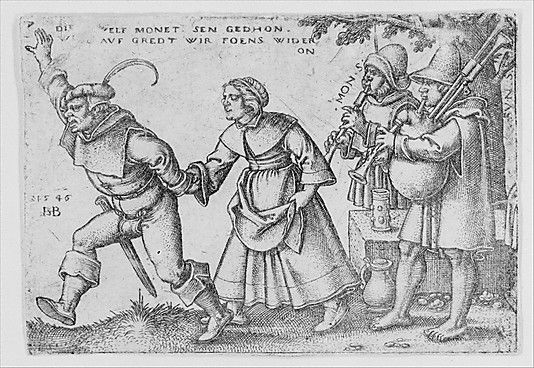
This lady is described as a dancing farmer and has probably done her fine dress for a festive occasion, with her hair braided in a nice updo and what looks like a headband around the head. She wears a dress and a gollar that looks fur-edged or with a whole lining in fur.
This piece shows the women working with flax, the process from plant to fabric demanded both time and hard work in numerous steps. The sitting lady wears a cap or veil around her head, with hair showing at the front. Her jacket is fastened at the front and is cut in the fashion of the time; low and square. The standing lady has her hair in braids around her head and has rolled up her sleeves while working. The dress has a decorative guard at the front, and is hiked up at the waist. Clearly, she is doing some heavy work!
Dressed for cold weather? She has done her veils around her head, chin and neck, and wears a short cloak against the cold. She wears both shoes, socks and hose, and a bag at her belt.
Ah, time for cutting some fleece! The sheep does look dead but is probably just laying at a convenient working pose for the woman, who use a shearing scissor for the work. She wears a simple cap or tied veil over her hair, and a dress with decorative guards at the front. It is hard to say if the brown skirts are part of her yellow dress, discoloured by time, an apron or a piece of cloth.
Festivities again! Do peasants and workers anything else than working and dancing? This lady has the common braids, a gollar and a dress. What is so interesting with this picture is that you can see the back of her dress, which is clearly denser pleated than the sides. Uneven pleating in the skirts is visible in more pictures and seems to be the result of tailored work.
Summertime, and work in the fields this time. Now we can see her shift; a plain linen shift with a long sleeve, and either a high collar, or more believable, a thin gollar/linen cloth to protect her against the sun, as is seen on the woman with the red dress. She wears a straw hat, and her dress is sleeveless; it is a tight-fitting middle kirtle or underdress that gives you the bust support you need, without being in the way for hard work. This layer can be found on other women too; plain, sleeveless and intended to be worn under the woollen overdress. It is only during heavy outdoor labour such as fieldwork, washing and shovelling it is openly worn, older women and richer women always have their overdress on.
Based on my research, I have found that I needed the following items for a whole outfit:
linen shift
kirtle or underdress
wool dress as an overdress
apron
belt
purse (and maybe a rosary too, it is mentioned in some written sources but doesn’t appear on peasants often)
cap, veils, a straw hat and/or a braided hairstyle
hose
shoes
gollar
jacket
cape/cloak
This much? I wanted to make a whole outfit, that would be practical during different kind of events with both cold and warm weather. I also wanted to try to make all the pieces of clothing and accessories that I have found during my research, to better understand how they worked together.
For more research, I have a Pinterest board on the theme if you want to learn more!
Making that matching outfit doesn’t have to difficult or impossible expensive, but it does take a fair bit of planning: before. Yes, I know it is the most boring part, but thinking before shopping is what makes the thing. So I put together a list of my best tips for making an outfit that makes everyone go “Wow” when they see it.
1. Decide on a colour scheme that you like, and follow it. You should have 2 base colours, with additional tones to match. In my case, orange and warm yellow is my main colours, as you can see on the amber necklace, the woven belt, the shawl and the apron dress. The hair band have a darker orange colour, but it is warm and intense to match the other tones. The red coat and the middle woolen dress brings in the additional colours to make the outfit interesting but have likewise a warm toned base.
2. Add some contrast or mismatch to intensify your matching outfit (yes, it works like that) it could be the opposite colour (red-green or yellow-blue) or a really dark detail to an otherwise light outfit. In my case, the green glass beads does match the yellow tones, but breaks nicely with the red ones. Still, they are in the same warm tone as the rest of the outfit. The uncoloured beige dress is another example; it doesn’t follow the main theme but have a warmer undertone so it works fine with the other warmer shades.
3. Patterns or texture adds interest and depth to any colour. My apron dress is woven in a herringbone twill, and the coat is a bit uneven in its colour due to different dyes in the fabric, which is barely visible but adds texture and interest to the finished garment.
4. Darker and lighter shades; when choosing your colours make sure you have different shades and not only different colours. For example; yellow-orange-red make for a change in both colour and shade, but a light blue paired with a similar light green makes the outfit a bit flat. Add a darker green or blue-green tone and you will make the outfit more interesting!
5. Layers; plan for all the layers at once, and make sure they have different tones, shades or textures if they follow the same colour theme. In this case, you won’t end up having two orange dresses on top of each other, and can make sure that details will be visible.
6. Details; don’t we all love a well put together outfit? Making details lifts an outfit, and it can be both jewelry, accessories as well as useful tools, a knife, a jug or something like. Match it in colour, tone, shade or shape to your outfit. In my case, I chose to make a tablet weave to reinforce the apron dress, make the straps, and a matching headband. Having the same colour/pattern appear in different places adds interest and makes the outfit look well planned and matching.
7. Consider your own colours; colour schemes and matching is a whole science on its own, and there is plenty to read or check out on YouTube. Matching colours, creating interesting outfits and the like works the same way on historical clothing as on modern outfits or make up. Consider your own colours, if you have a warm or cold undertone in your skin, and consider what you like to wear. Using those kinds of colours will both make you more comfortable and happy during historical events. But also consider the historical finds; if you love to wear black and dark blue maybe that is not the best choise for your farmer viking outfit. But as these are considered as neutral colours in our modern eyes, maybe a dark grey with soft, plant dyed blues will do great for your viking outfit?
Got inspired? Did you find this guide useful? Please let me know by liking my FB page or leaving a comment on the blog!



 There are plenty of bathing dresses in paintings from the late 14th to 16th century in Europe, they can also be seen in different cuts and models, and some are clearly supportive shifts that you could wear under your medieval clothing. Mine is very simple but with an intake under the bust to allow some support, but still being easy to get in and out from. No lacing is acquired.