HANDCRAFTED HISTORY


3 Comments

Tutorial; the bathing dress

Some time ago I made a medieval bathing dress in unbleached linen, and I wanted to share it with you. It is a simple project, perfect for an evening or if you want to practice hand sewing.
20180713_163324There are plenty of bathing dresses in paintings from the late 14th to 16th century in Europe, they can also be seen in different cuts and models, and some are clearly supportive shifts that you could wear under your medieval clothing. Mine is very simple but with an intake under the bust to allow some support, but still being easy to get in and out from. No lacing is acquired.

Left; Bohemian, Codices vindobonenses 2759-2764 in the Osterreichischen Nationalbibliothek, in Vienna, Austria. Right: The Bathhouse Attendant, Bible of Wenceslaus IV. 1389.

Chemise ladie's undergarment, 14th century, A History of Costume; Kohler.

This find is from A History of Costume, Kohler and is dated 14th century and described as a lady’s chemise or undergarment, the photo is old but you get the general idea.

Most of the pictures I have found seems to be dated to the late 14th to early 15th century, there are lots on the internet and I have a Pinterest folder on Medieval underwear so I won’t go into more historical sources today.

The cutting out; prewash your linen, fold in double in the length you would like, and then cut the A shape. I used the leftover fabric for gores in the sides (and at centre front + back if you like, it is optional) but this of course depends on your measures.

The first pictures show the general cut, the second the additional front and pack gores, the third the intake under the bust that give me the support. Do not take in too much, because then you won’t be able to get in and out of the dress.

20180818_103244

About measures: The length of the dress measures from armpit to hem. The width is your measure around your bust divided in two (for front and back) add seam allowance but nothing more. Start the gores at your natural waist (if you are unsure, rather place them higher than lower) and pin the intake under your bust while wearing the dress with gores and side seams sewn/basted. Add shoulder straps last, mine is just double-folded linen cloth, whip stitched together and then fastened at the same position as I would have worn bra straps.

If you sew your dress by hand, use waxed linen thread and running stitches, and then fold the seam allowance to one side and whipstitch in place. This gives you a sturdy seam that is also quick to make. Hem the dress with running stitches or whip stitches, after your choice.

Making the dress in unbleached linen made it opaque even when it was wet, good for modesty. In artwork the dress seems to be white, may be visible nipples was a thing, or you would have to pick a very dense fabric. In some pictures, it is very clear that the fabric is transparent, but I chose the more sturdy and practical look. (update spring 2021: I have found that if you start with unbleached linen fabric, and sun bleach it yourself you will get an almost white fabric that is not as transparent as the modern bleached options in stores.)

The result? All considered, I am satisfied with the cut, sewing and look of the dress. It is also easy to swim in. Historically, being out in public in a bathing dress was not a thing, they can be seen on bathhouse attendants or in rare cases during the dressing/undressing at home or during dirty labour. Wearing it to the beach was certainly not a thing, but I liked to have a more historical dress instead of wearing a modern bikini when going for a swim at events.


Leave a comment

Going to Hamar in Norway

Me and my friend J traveled to Hamar in Norway this May to attend the medieval festival/market over a weekend, and here is a blog post about the event!

IMG_2744

It really was a beautiful site, with the large lake stretching around the market and camping area, inviting for a swim in the warm weather. This is the reenactment camp, very nicely done and with an area for shows, riding and the like in front of it.

IMG_2745

A short walk from the camp was the market, with lush green trees and an open space for market tents and performances.

20180608_202109

Here is my tent! In a cozy corner in the road, under a big tree. We arrived the day before the market started so the first evening we just put up the tent, made some preparations and went about greeting friends and taking in the area.

20180610_085145

Morning in the tent, hearing tree branches whispering in the wind and feeling the sun rise on the tent side.

IMG_2746

Crafthive was on the market, selling belts and nice bags, among other things.

IMG_2751

I also sold things from my shop, mainly historical accessories and jewelry, sewing materials and handcrafting items. It is fun to meet new people during markets, but more often than not I start talking with them and forget that I should sell my stuff… I really like holding workshops and lecturing more, but the shop is a nice way to be able to visit new places and travel more!

IMG_2761 (2)

When no customers needed help, I sat down with new and old friends, having a chat and sewing on my new dress. Here it is, worn for the first time! The neck opening is just basted, but it was fun to get a chance to try it on. 15th century (yes, it’s much of that century right now) with proper hair and veil for the period.

IMG_2739

I got a chance to visit this very interesting ruin, saved inside a glass room on the site.

IMG_2742

And a visit with the Madonna and Child, a wooden sculpture made between 1200 and 1300 in Norway according to the sign. (Yes, visiting only in my shift! It was sooo hot that day)
20180610_171817

I found Volundr on the market, and they sold the most lovely handcrafted jewelry based on different historical finds. When I laid my eyes on this 15th c necklace I promptly emptied my money-box over their table, and went back to my own tent much happier but also more broke…

20180610_214425

After the market on Sunday, the wind had turned and there was rain in the air. We hurried to take down the tents, pack the cars with all stuff and then went to see if others needed help. Elna from Historical fabrics is my new favourite seller of thin linen for veils (among other things) and she was packing away her tent and all the fabrics when we came by. Phew! Fabric sellers have the worst time packing, we helped with some rolls of fabric and tent gear but there was some advanced tetris before she was finished.

I really love going on historical adventures! On the road towards Hamar we traveled across the mountains, some of them with snow still left, and then over the border to Norway and some very nice views along the way. It was sunny and we had a picnic packed in the car. On the road home, I was traveling alone since J had to go by train back to Stockholm, I hadn’t any food left and the weather was cold and rainy. Then the adventure seemed a bit less fun. But as they say; it’s good to leave on a journey but it’s great to be back home!


Leave a comment

14th century cotehardie

I have been reading up on 15-16th century medieval Europe, including art and clothing, for some years now and haven’t really been into the 14th century for a while; I even sold of my Moy Bog gown and some other dresses. But then my friend J told me she wanted to brick stitch embroider a couple of purses, and I could have one in exchange for a minor handcraft effort (at least I thought so- I’m not really into embroidery…) and then I would need a fitting dress to that… And in almost no time I had this one finished, a hand-stitched cotehardie made of thin wool twill, with silk lining, silk lacing at the front and short sleeves.

The dress is for the higher classes, and in pictures from the late 14th century, it is worn with a kirtle underneath (a tight-fitting dress often with buttoned sleeves). Then it seems like the dress remains in the beginning of the 15th century, and is worn as a kirtle/middle dress with loose sleeves for a more fashionable look. After that, the dress seems to change a bit into the waist seam dresses (like my blue Weyden dress). This kind of dresses is very common in contemporary art and you can see them in different countries, with long or short sleeves, a laced front or a hidden side lacing, and with buttons or lacing at the sleeves.

If you would like to make a dress like this for yourself, search late 14th and early 15th art sources (I have some at my reading tips) or look at my Pinterest board about cotehardies.

Here are my best tips for making the dress fit nicely:

  • Fit the sleeves in carefully, they should be snug around the arm for both good movement and the right look.
  • Make the lacing holes 1,5-2 cm from each other, no more, to make sure the lacing will not show the shift underneath.
  • Use a lining inside the dress to make it more supportive for the bust, to add shape and draping to the skirt. If you have a tight fabric budget; just line the upper body.
  • Try the dress on often during your work with it, and make the lacing before hemming and neckline. Also, you may fit in the dress at the end for that perfect look by leaving the side seams open until last. These are also good to leave open (just back stitch them and secure the selvedges if necessary by zigzag or whip stitches) for adjusting shape, support or weight loss/gain in an easy and fast way.

In these photos, it is worn with loose silk brocade sleeves, but I’m planning on making a kirtle for it with long sleeves to wear under. On the head, I wear my hair in temple braids, and then a silk tablet woven hairband. The veil is pinned down to that, and then I have a woollen hood for warmth. The gloves are modern and just for warmth, it was really chilly to go out with just one dress.

This was the first event trying it out, and after that, I have been adjusting the dress a bit. Inside lining; the silk fabric getting snowy outside.

Hairband, pins and veil.

Historical accurate? The model is quite common for the late 14th and early 15th century, and the silhouette of the period is a rather straight and smooth one, which I have tried to achieve by making the dress a bit loosely fitted around the waist and hip area, in order to get the lean look of the time (I am built a bit too curvy for the 14th c ideal). The woollen twill fabric with its blue colour is representative for the periods upper class, blue is a common colour in women´s clothing during the medieval period, and the twill weave is fine and good looking. Dresses showed in period art often has a contrasting coloured lining, but it seems that this was most often in wool, linen or mixed fibre fabric, while silk blends seem to be more common during the 16th century. For a more historical dress, I would have lined the dress in very thin wool or made the whole dress out of silk. The pink, hand woven silk was chosen for its cheap price (1/3 of a wool fabric of the same weight), its look and the lightness of the fabric, making the dress comfortable and not hot at all.


Leave a comment

From the SCA event Majgreve

This May I went to a small and cozy weekend event outside Stockholm, to watch the Majgreve tournament and meet with new and old friends. It was such a nice event, the weather was perfect and the site beautiful.

IMG_2597

IMG_2612

Wow, what a site! Don’t you want to go for a swim?

IMG_2669

During Saturday, everyone hanged outside by the lake, having lunch picknick-style, playing or chatting with each other.

The fighters got hot; so they continued to practice in the lake.

IMG_2622

I also got too hot, and decided for a swim in the lake. It was very cold, but very nice! I didn’t take any bathing photos because of no swimwear, but look at how happy I was afterward!

IMG_2698

I put up my shop on the grass and tempted children with stuffed horses and adults with shiny jewels. Works every time!

The jug sneaked around the bush, going on adventures of its own. Who owned it? Don’t know, but I know that it is based on a find of a medieval clay jug.

IMG_2614

Court in the shade

IMG_2634

IMG_2668

Afternoon sun by the lake

IMG_2654 (2)

In the evening, tables was set outside by the shore and on the pier, and everyone enjoyed a pot-luck feast together!

IMG_2711

IMG_2706

And finally, some photos of fellow SCAdians! I always try to take some photos and/or portraits during events, to let you meet some of all the amazing people I get to meet during my adventures!

IMG_2684

IMG_2653

IMG_2643

I had an amazing weekend, and really recommend you to visit a SCA event if you haven’t already, or to visit Majgreve next year if you live closer to Sweden and Stockholm!

IMG_2688

Wearing my 16th century trossfrau outfit during the event. If you want to know more about it, read my other blog posts about 16th century clothing, and check out my tutorials on the subject =)


4 Comments

Medeltidsveckan på Gotland!

Wow, time sure runs fast during summer. Now it is only 2,5 weeks before the medieval week in Visby, on the island Gotland here in Sweden and I have lots of work to do before we travel there. Me and love will be traveling with our friend L, and as usual, I will be at Kapitelhusgården holding workshops during the week. If you want to attend one of them you can prebook here.

There will also be a Secret Shop opening on a Secret Location in the market place during the week. If you know what I’m talking about- watch out for the sign!

Anyway, I haven’t had the time to write new posts for you, even if I have heaps of good photos and adventures to tell you about. They will have to wait until autumn, and instead I wanted to give you some reading tips (in Swedish and English) if you are preparing for Visby (or any other medieval/viking event) and want some inspiration.

Some photos from last week 2017

…and more photos from the year before

The list I wrote some years ago for packing for a medieval tent event

My guide (in English) to the Medieval week and in Swedish

Hope you will enjoy these links, and if you are going to visit Visby- I would be so happy if you came by and said hi to me =) Some of my most dear memories includes meeting readers and making new friends during the medieval week!

IMG_2290 (2)


6 Comments

Tales from Double Wars

We went to the SCA event Double Wars in southern Sweden (Skåne) and traveled from early snowy spring to full summer in a day. Magical event on a beautiful site, and a really large historical camping ground. The drive took about 15 hours, so we divided it in two days and made some small stops and side trips along the way, like visiting historical buildings and eating ice-cream.

I am working on photos from the event, so the following blog post will be about the event, site, camp and lots of inspirational photos for you- hope you enjoy it!

The new red dress, late 14th century, in red wool with pewter buttons and front lacing. Since the event took place in early May, a warmer dress like this was a good choice. Being photographed in the camp site

Out new tent from Tentorium; we are really satisfied with the quality and the rainproof fabric, it kept us dry and comfortable living during the week-long event. Took the photo one morning, getting dressed in the late 15th c green kirtle (I will come back to this outfit later in a separate blog post)

One day we went for a short stroll down to the lake, through magical green forests with woodgarlic and birdsong

Do you remember my green houppelande with rabbit fur? I sold it, and tried out a new  model (how else to learn?) in a green high quality wool, lined with silk and trimmed with the same silk fabric, to imitate a painting I got inspired by. I call it the Weyden outfit; and I will write more about it when I got the time.

Love is feeling very well now, and was spending most of his time hanging around the archery, practicing or just having a good time. He is wearing a 14th century outfit, made of wool.

I also like archery, and discovered that most of my outfits was wearable for shooting and handling the bow. Even the fancy new red dress, with large veil was ok. What I didn’t like? My straw hat and the temple braids; they got in my way.

Here with love, practicing archery

Strolling around the camp groundsMarket day, love is jumping in to help some customers, while I had a snack and talked about clothing with friends.

jagochaleydis

Me and Aleydis by the lake, she was swimming in the cold water, while I was minding the sun…

Do you like what you see? SCA is a big organisation that is active in lots of European countries, USA, as well as other places around the world. Google SCA and your country or city to find out if you have a local group to join- SCA is friendly for beginners and there is lots of help and friends to have if you want to join in and journey with us to long-ago-times!


2 Comments

The 16th century working woman – Research

This is a post about (one of) my 16th century outfits; and due to several years of research, work and sewing experiences it will probably be more than one post, with different subjects. In this, I will give you an overview and some background research. The outfit is already finished, worn, mended and in line for some redoing, so I will be able to share the whole process with you; both good and bad outcomes and what I could have done differently.

My aim was to make a good recreation of a whole outfit for a woman from early 1500s German (or possibly southern Scandinavian area, since this was influenced by German fashion at the time). She is not poor but works for her living, maybe on a larger farm or in a smaller city. She is well dressed; as is the ladies on all the art I have studied, but like other working women, she owns practical clothing with a skirt short enough to stay out of her way, and a cut to the clothing that is both economical and practical. Contrary to the trossfraus (the women who follow the mercenary armies) she does not wear slashed and mismatched clothing, but items that belong to each other and to a certain class in society. She follows sumptuary laws and does her hair in the braided fashion, or covers it with a simple cap and veil while working.

I wanted to show you some interesting images of 16th century women in art so I put together some examples for you;

Three women; wearing work tools but also lots of interesting clothing. The shoes are practical and the skirts reach the foot, not the ground. 

A painted glass piece showing the milking and making of butter. A (probably) younger woman has her hair in two braids, and a covering apron to protect her clothing. The older woman has a veil, a jacket and a dress hiked up in her belt.

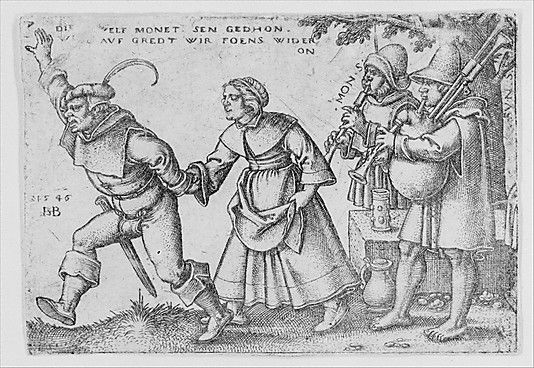
This lady is described as a dancing farmer and has probably done her fine dress for a festive occasion, with her hair braided in a nice updo and what looks like a headband around the head. She wears a dress and a gollar that looks fur-edged or with a whole lining in fur.

Another dancing farmer- with a gollar fastened by her neck, and an apron around her waist. The shoes look sturdy and practical (but nothing like the cowmouth shoes you can see on trossfraus) and she has some kind of decorative border at the hem on the skirt, and on her loose sleeves. No slashes though!

This piece shows the women working with flax, the process from plant to fabric demanded both time and hard work in numerous steps. The sitting lady wears a cap or veil around her head, with hair showing at the front. Her jacket is fastened at the front and is cut in the fashion of the time; low and square. The standing lady has her hair in braids around her head and has rolled up her sleeves while working. The dress has a decorative guard at the front, and is hiked up at the waist. Clearly, she is doing some heavy work!

Dressed for cold weather? She has done her veils around her head, chin and neck, and wears a short cloak against the cold. She wears both shoes, socks and hose, and a bag at her belt.

Ah, time for cutting some fleece! The sheep does look dead but is probably just laying at a convenient working pose for the woman, who use a shearing scissor for the work. She wears a simple cap or tied veil over her hair, and a dress with decorative guards at the front. It is hard to say if the brown skirts are part of her yellow dress, discoloured by time, an apron or a piece of cloth.

Festivities again! Do peasants and workers anything else than working and dancing? This lady has the common braids, a gollar and a dress. What is so interesting with this picture is that you can see the back of her dress, which is clearly denser pleated than the sides. Uneven pleating in the skirts is visible in more pictures and seems to be the result of tailored work.

Summertime, and work in the fields this time. Now we can see her shift; a plain linen shift with a long sleeve, and either a high collar, or more believable, a thin gollar/linen cloth to protect her against the sun, as is seen on the woman with the red dress. She wears a straw hat, and her dress is sleeveless; it is a tight-fitting middle kirtle or underdress that gives you the bust support you need, without being in the way for hard work. This layer can be found on other women too; plain, sleeveless and intended to be worn under the woollen overdress. It is only during heavy outdoor labour such as fieldwork, washing and shovelling it is openly worn, older women and richer women always have their overdress on.

Based on my research, I have found that I needed the following items for a whole outfit:

  • linen shift
  • kirtle or underdress
  • wool dress as an overdress
  • apron
  • belt
  • purse (and maybe a rosary too, it is mentioned in some written sources but doesn’t appear on peasants often)
  • cap, veils, a straw hat and/or a braided hairstyle
  • hose
  • shoes
  • gollar
  • jacket
  • cape/cloak

This much? I wanted to make a whole outfit, that would be practical during different kind of events with both cold and warm weather. I also wanted to try to make all the pieces of clothing and accessories that I have found during my research, to better understand how they worked together.

For more research, I have a Pinterest board on the theme if you want to learn more!


Leave a comment

The Medieval Wedding Dress- the velvet gown

This is the final layer I made for my wedding outfit, it is a silk velvet dress inspired by the late 15th century over dresses. The gown is open at the front to allow for easy undressing, and to show more of the white dress underneath. This can be seen in paintings, though a closed gown would have been more common.

This was one of the most difficult garments I have ever made. The fabric is a silk velvet, sensitive, very thin and extremely flimsy; I so understand why silk velvet has been replaced by synthetic alternatives on the market (and it is not just a matter of price). The gown is fully lined with silk dupioni for support and look, and has linings in black silk taffeta and on the bottom, the same black high quality wool as in my love’s joined hose. I opted for the golden coloured silk because it did so well under the velvet, and made the velvet shine even more. if using a transparent velvet; try out different shades of lining fabric to find the one that gives you the look you want.

The gown closes with a small hook and eye at the waist, and then this belt is added. The bronze buckle and strap end is made after a painting from the period, and can be seen on houppelandes and similar overdresses from the period.

Working with the fabric. Here you can see the silk lining being laid out at the velvet to act as a pattern piece. The velvet was very sensitive, so pinning was only an option in seam allowances.

The fabric being so thin and flimsy, pinning it to the sturdier silk lining was a good help for cutting, basting and sewing. I treated the two layers as if they were one when sewing, making the seam allowances visible on the inside of the dress. Since the velvet is transparent where the pattern is, it was not an option to have the seams between the both fabric layers.

Front and back pieces of the body being laid out. With a patterned fabric, you might want to consider where to put your pieces, and in what direction. I let the two front pieces have the pattern laid out in the same direction, and then turned the back piece upside down, since the skirt would have the pattern visible in the same direction at the back of the gown. The two fronts doesn’t have to be similar in pattern, all contemporary art depicts uneven patterns on the front of dresses.

You may also note that the front lining pieces have the selvage running along the openings, since the velvet was stretchy, and silk stretch when cut on bias, I laid the pieces out diagonally on the silk fabric to have a non stretchy front, and instead add some flexibility across the body. This way, there is some small movement allowed over the rib cage, while the front lays flat against the body.

I sewed the gown together on the overlock machine, this was one of my best choices ever since the seam both helped with protecting the seam allowance and allowed for some stretchiness in the skirt. After the gown was put together, I hang it on my doll to let the skirts fall out. Fabric cut circular like in this case always seems to hang out unevenly…

And yes it did! I ended up cutting away between 10-15 cm in some places, but only 2 in the areas running along the fabric length. I was quite nervous- cutting a little each time and allowing for the fabric to adjust. There was some massive pinning and measuring and swearing going on at this part and frankly, I just forgot to take pictures because I was so frustrated. Here you can see the velvet skirts hanging out, the silk lining behaving all nicely and staying in shape.

After this, I worked with the hems and inside seams by hand. All the seam allowances were folded down, basted to the lining and then covered by a strip of silk fabric, whip stitched down. No ironing though; velvet does not go along with pressing so the seams were just smoothed out by hand. The front opening and the sleeves were lined with black silk taffeta, the same as love’s doublet were edged with.

The bottom needed a little more heavy lining, and I wanted something that could take some more wear than silk so I chose a thin wool tabby weave. Here it is, laying on the floor.

One of the seams, seen from the outside when finished of. The whip stitches securing the strip inside is not visible on the outside velvet, neither is the machine seam that holds it together.

I am very pleased with the dress, I really plan on using it in the future on events. It was not easy to make, but hopefully some of my experience shared with you will make you want to try one for yourself if you wish!


Leave a comment

The Medieval Wedding Dress; the silk dress

I am sooo behind writing about my different projects. I kind of have a bad conscience about it too, and I really try to work through all of my drafts, notes and old photos. I guess it has been quite the autumn and winter here, I really never post about those parts of life, but I like everyone else have tough periods in life. Life, dead and bills happens to everyone, as the saying goes. I am not going to talk about that today; I am going to show you my wedding dresses!

I made three different layers for the wedding outfit. A linen shift, a cream-white silk dress and the velvet silk over dress. The linen shift is made tight fitted, with thin shoulder straps and a supportive body, and then a loose skirt. Over that I also wore a linen petticoat with a strengthened hemline. It never shows, but it adds important stability to the cream silk dress so the skirt drapes the correct way.

Over these I have the silk dress, cream-white and lined on the inside with a really thin wool muslin fabric. The silk fabric is a taffeta, and even if that quality is a lot sturdier than other silks, it still needed to be lined for a better draping skirt and a smoother upper body. Here you can see some of the effect the petticoat has; making the dress skirt stand out a bit instead of hanging down. The taffeta also helps a lot.

The sleeves are unlined, instead I have the thin silk sleeves that is shown underneath. I didn’t want another layer underneath the silk dress, so the thin silk sleeves are just lose sleeves, attached by the arm hole on the dress. The lacing is made with silk thread, the same as I did the lacing holes with, and also the white freshwaterpearl belt. Around the wrist small pearls are fastened, kind of like a bracelet but easier to wear.

For these dresses I made full mockups in cotton fabric to get a feeling for the pattern drafting and models. Usually I like to improvise a bit, but now I somehow was patience herself while drafting… The skirts in both dresses are based on a full circle of fabric, that is what gives the dresses that magical drape and the deep folds in the fabrics. The mock-up was then taken apart and used as a pattern, here is half the skirt on the cream silk. Yeah, I actually cut out my fancy white silk dress on the floor, with heaps of fabrics laying everywhere. Creativity, you know…

More fabric, this is the other half of the skirt.

To prevent the silk fabric from fraying I sew all edges with a overlock. You can use a zigzag as well, but it is good to prep them in some way. I would have liked to sew all our garments by hand, but neither time nor my fingers allowed for it, so edges and some inside seams were made with sewing machines. The overlock really was my best friend when it came to the fraying silk fabrics.

I also reinforced the hemline of the dress with a thin fabric strip. This was pinned around the hem, and then sewn with a machine stitch. After that the lining was added so the strip was hidden on the inside between outer and inner fabrics.

Here is a nice close up on the silk lucet cords, the lacing holes and the matching silk belt with freshwater pearls. I really liked how the cream-colored fabric, the silk thread and the pearls matched each other


The dress has a waist seam, so it really is a circular skirt, a regular body with side seams/side lacing and set in sleeves, all in all a simple dress. Here you can see the waist line, the seam done by hand to get a good drape of the skirt and because the different layers of fabrics really liked to slip against each other.

A good view of the laced up sleeves from the side

And a view from the back, while walking in to get married.

This actually became quite the long blog post, so I’ll get back to you with the velvet over dress in a post of its own!


2 Comments

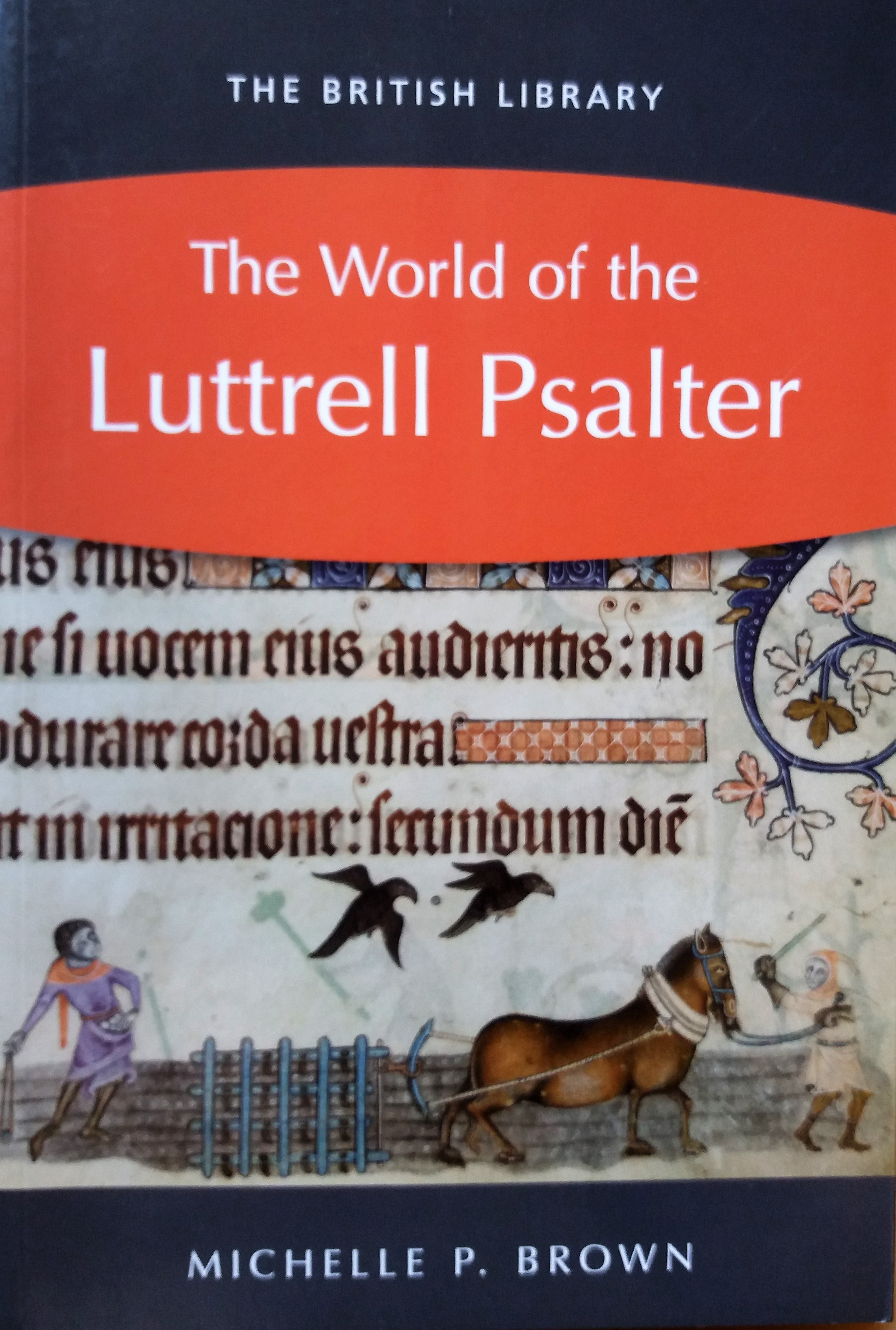
The Luttrell Psalter

I purchased this book on a whim, and was happily surprised! It is a really good presentation of the Luttrell Psalter (from 1330) and richly illustrated with both religious and every day paintings inspired by 1330 England. If you have an interest in this period, likes illuminating manuscripts or just want another good book for your medieval library this is a must-read!

I really liked all the pictures of everyday chores and people in the book, me being somewhat of a nerd on period clothing (have you noticed…?) lots of detailed clothing, hair styles and accessories.