

The last 1- 1 1/2 year the 15 century has been one of my main interests. It is a really interesting period in history, with lots of changes in both politics, society and how trade, money and people moved. My main interest has been the clothing in middle Europe, around what is today Germany, Belgium and the Netherlands (more or less, influences and fashions spread and you can see similar styles in areas boarding to these ones).
From these areas came several great artists, there are lots of paintings and artistic work left, and Scandinavia were greatly inspired by the clothing and fashion movements from the German area.
To both challenge and inspire myself I decided to make a Golden Egg challenge on the topic of 15th century clothing. The Golden Egg is a household in the SCA; you can read more about it here. My goal is now to research and make a whole outfit from the late 15th century for myself, and the timeline is one year between start and presentation.
I wanted to share some of my research, as well as some good sources for you to read for yourself. My main interest is the clothing for women, but you will find lots of good inspiration for men’s fashion as well.


Some important points to remember when studying 15 c fashion (or any historical fashion really) is:
- The diversity of the period. Fashion shifted over a certain time, and during the 15th c it shifted quite fast. It also differed over areas (such as towns, countries) as well as social classes. It is not possible to sum up the period by stating “a women wore this and this, in such a way” but some things are similar, like wearing a linen shift, middle kirtle and over dress of some kind. How these looked, what materials they were made in and how you wore them differed greatly, as did the accessories.
- The art and paintings of the period is a really good source, since there’s a lot of them, and the fashion of art suggested a natural, realistic reproduction of the people living during that period, with lots of details regarding seams, models, fashion and materials. This was also the period when portraits became popular for others than the nobility, with the ever-increasing burgher class economy as a base for portraits. This give us a source of good depictions of people of the time, and also gives a good clue on what kind of clothing and headwear was in fashion. It is important to note that there also were sumptuary laws regarding what you could wear, and how you were to be portrayed according to your status in society, making the understanding of art and symbolic meanings very important.
- Religious art was also very important, and great artworks were often the result of a whole workshop with different painters, studies and sketches from different areas and periods, as well as saints depicted with biblical clothing and symbolic tokens. This means that you can find different styles in one and the same painting, both considering fashion and the style of the artist, even though the master overlooked the work on each artwork. It also means that flowing robes and cloaks that appear might not be the fashionable items like the gowns and doublets right beside them, but more some kind of biblical clothing.
- Colours, technics and styles regarding painting developed greatly during this century, with the use of different mineral sources etc as a way of getting vibrant, expensive and fashionable colours. But this does not mean that the colour tone on a painting was the same as the depicted garment from sketches and models; the colour was foremost the result of the client’s budget, where vibrant reds, dark blues and golden inlays were important for the fashionable and rich client. Does this mean that paintings can’t be the source for fashion studies? No, of course you can look at art for getting an idea of the clothing of the time. Just keep in mind that the colour that you see on your computer screen is the result of both a computer screen setting, the photography of the painting (with editing) how well the painting has withstood time (mineral paint tend to change over time) as well as the idea of what a really expensive colour looked like in art versus fashion.
- Artists of the time was more handcrafters and less artists in our modern use of the word. They trained for masters, belonged to workshops and worked with paintings as a team, not as one expressive personality. The money came from churches, rich nobility and the burgher class who commissioned art pieces (or bought ready-made pieces) such as piety paintings, portraits and, later on, everyday scenes from their home. This means that art was the result of society, fashion, study and individuals, greatly inspired by the ongoing social development as well as other painters. Of course there were room for personal style; compare Rogier van der Weyden to Durer and you will find style differences, even if you are not a trained art historian.
- The artist had knowledge about the fact that fashion shifts; and that what was worn everyday when the paintings was made, was not the clothes of the time depicted in them. So in a painting of Christ’s birth; you can se both people dressed in the high of 1470’s fashion, as well as mythical and religious figures dressed in cloaks and robes that were meant to be seen as “some kind of long time ago clothing”. This might be pretty obvious, but to make it a bit trickier there is also paintings with 14th century fashions depicted (in a rather loose style) in 15th century paintings.
- Dress for your age; as for society today, people tend to dress after their age, with the young girls and women of that time preferring high fashion dresses, loose hairstyles or flowing hair for the unmarried (or soon to be crowned queens) while older women seems to be more covered, with additional layers and more elaborate veils. Older women can also be seen in “unfashionable” garments; what was the thing 10-20 years ago at their prime seems to hang along.
Having this in mind, you can clearly se that if you aim to make an outfit as historical accurate as possible (…possible for your means, skill etc) an important start is to choose a certain time and period. The social standing is also important, so a good starting point could be a woman from south Germany (or a city of your choice) from the wealthy burgher class, who lived during 1450-1470.
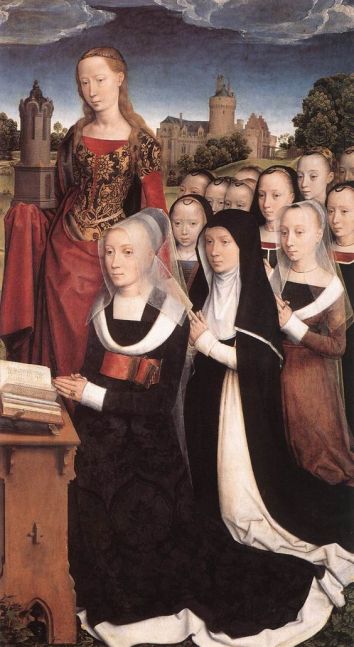

I have chosen to focus on the area of Germany, the Netherlands and the Flemish region. This because there were some great artists living there that I want to study further, but I also enjoy the fashion of that area and how the geographic areas and countries influenced each other. If you compare this areas to (for example) Italy or France, you will find that both style in art and fashion differs greatly.
Another thing to consider, is to search for sources besides art; like finds, surviving clothing items, sketches, written documentation etc. This will give a depth for your understanding of the period, where the beauty ideals and painting technique might touch up certain details to the point of it being difficult to interpret (like, how did all the women have those small round breasts sitting high up on the body?)


These are some important painters and artists from the German/Netherland/Flemish (Belgium)/Burgundy region during the century that I have chosen to study in more detail:
(About the dating: Sometimes it is difficult to find the year of birth/death for individuals, so the dating in uncertain, but it will provide with a overview of when they lived and were active)
- Limbourg brothers (1385-1416) Germany
- Hubert van Eyck (1366-1426) Flemish
- Jan van Eyck (1395-1441) Netherlands
- Rogier van der Weyden (1399-1464) Netherlands
- Petrus Christus (1410-1476) Netherlands
- Hugo van der Goes (1440-1483) Netherlands
- Hans Memling (1430-1494) Netherlands
- Hieronymus Bosch (1450-1504) Netherlands
- Gerard David (1460-1523) Netherlands
- Hans Holbein the Elder (1460-1524) Germany
- Albrecht Durer (1471-1528) Germany
If you are interested in this period and want to learn more about the art, there’s some good books about different artists, and this really good (and free) article at Wikipedia about the subject.
I have also studied books on different artists, the Prestels “Masters of Art” series have been very interesting. There you can find both Van Eyck, Durer and many more.
Want to see more artwork from the time? Check out my Pinterest folder!